The World Wide Weird: Weird Fiction Review

November 5th, 2011 § 0 comments § permalink

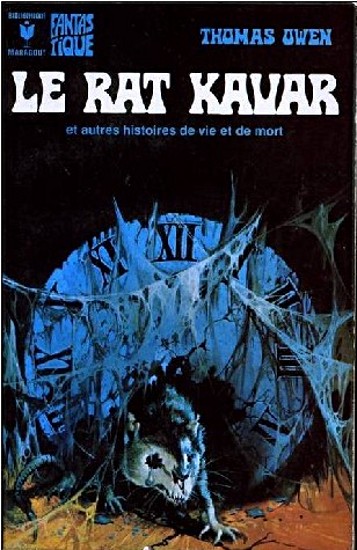
Ann and Jeff VanderMeer’s big top of weird wonders has premiered! Your one-stop shop for weird in all its stripes, colors, shapes, and textures, from comics and interviews to fiction and reviews. This is the hub the wheel of weird revolves around, the bale-eyed brain and source of all things tentacular. Check out the bottomless goodie bag of round tables, exclusives, podcasts, and previews, and stop by my translation of Belgian horror writer Thomas Owen’s story “Kavar the Rat” now in print for the first time after its podcast debut at Pseudopod!

The cauldron bubbleth over: there will be “new con­tent on WFR every week day through the end of the year, exclud­ing hol­i­day weeks, and then to either con­tinue on a daily basis or post dis­crete “issues” of the site. Keep the broth abrew, and hit that PayPal button while you’re at it: the site is currently running on dona­tions only. I am proud to announce that I will joining the site as a regular guest columnist, so please feed us weirdlings! Don’t let us go hungry! A ha’penny will do! (If you haven’t got a ha’penny then C-thul-hu!)

Next week’s features include:

—An extended excerpt from China Mieville’s after­word to The Weird
—Three fea­tures on Alfred Kubin, the first author in The Weird, two by Paul Smith
—The next episode of Leah Thomas’s web comic and an inter­view with the cre­ator
—An exclu­sive fea­ture from Jim Kelly and John Kessel on their Kafkaesque antho
–Inter­views with Thomas Lig­otti and Margo Lana­gan
–Video cov­er­age of the extra­or­di­nary Cute & Creepy art show
–Fic­tion from Jef­frey Thomas: “The Fork”

At last! I’ll be working on some David B.

November 5th, 2011 § 1 comment § permalink

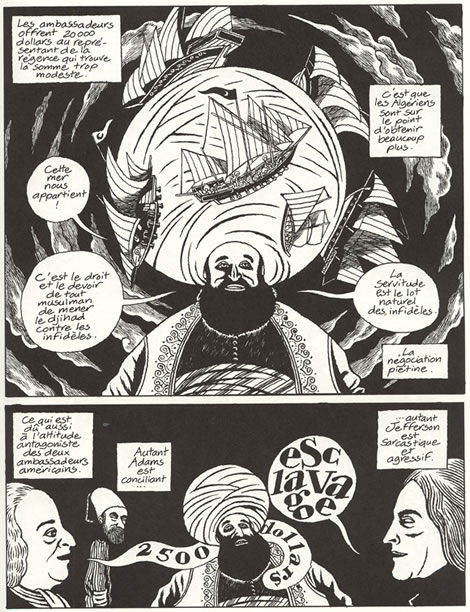
There’s been some buzz on the interwebs already among comics fans in the know about the first of David B.’s two-volume history of U.S.-Middle Eastern relations, Best Enemies (Les Meilleurs Ennemis: une histoire des relations entre les Etats-Unis et le Moyen-Orient). Co-written with Jean-Pierre Filiu, Book One, which covers 1783-1953, was just published this year by Futuropolis, Gallimard’s powerhouse indie comics arm, which has brought out most of David B.’s post-L’Association work. Paul Gravett, Britain’s brilliant indie comics pundit, posted a nice appreciation of it in a timely 9/11 blogpost. Beginning with a retelling of the tale of Gilgamesh, this first volume runs from the naval wars with the Barbary pirates through the WWII machinations that cemented the Saudi-U.S. bond. That’s Jefferson in the page above, lecturing Sidi Haji Abdul Rahman, Tripoli’s envoy, on slavery. The amazing little British publisher Self-Made Hero will be bringing the book to the U.S. and U.K.

Most stateside mentions of the book were tied to reviews of Craig Thompson’s Habibi, usually compared to David B.’s The Armed Garden (the two works probably shouldn’t be compared, since they have very different aims, though David B. largely dodges the accusations of Orientalist slumming currently leveled at Thompson by being at once more narratively inventive and aesthetically hermetic). I’ll say it now, and I’ll say it here, since only sixty people read this blog a few times a year: thank God more David B. is coming to the States. As both an artist and writer, David B. has been one of the greatest talents on the French comics scene for the last twenty years, and it’s about time he emerged from the shadow of artists he influenced (Thompson) or taught to draw (Satrapi). Because of the weird time gap it can often take for most foreign artists to make it in America, David B. will probably come to seem reminiscent of artists who couldn’t have existed without him. Let me grouch about this some more. Part of this is almost certainly childish “I knew about this first” pride, or a hipster grumble. I was into David B. before what I hope will be the era of his universally acknowledged cool.

David B.’s U.S. career took a big hit after his masterpiece of a memoir Epileptic, mismarketed by Pantheon in the wake of Persepolis, tanked. For a while the only David B. you could find were short pieces in Fantagraphics’ Mome, a handsome organ that mostly preaches to a faithful choir. But his talent is such that recognition proved inevitable, and the awareness begun back then seems to be turning into a groundswell. A few years ago, NBM put out a book of his dream diairies, Fantagraphics did The Armed Garden (collecting some pieces that had already appeared in Mome) and The Littlest Pirate King (Roi Rose, which David B. adapted from a Pierre MacOrlan short story). Self-Made Hero did his two-book story on Italian poet Gabriele d’Annunzio, Black Paths (Par les chemins noirs). In other words, David B. was poised for a comeback. Problem for me was that these fine and reputable publishing houses had longstanding traditions of working with certain translators already (NBM with Joe Johnson, and for Fanta, co-founder Kim Thompson). Edging in an excerpt from an early David B. piece, A Bomb in the Family (La bombe familiale), at Words Without Borders was the best I could manage. There’s almost nothing the man’s done I don’t like, from standalones to dream diaries to unfinished series to collaborations: Le Tengû carré, La Lecture des ruines, Le Cheval blême, Les Complots nocturnes, Les Chercheurs de trésors, Urani, Le Capitaine écarlate, Hiram Lowatt et Placido, Terre de feu… A review of Thomas McGuane in the New York Times once claimed he “makes the page, the paragraph, the sentence itself a record of continuous imaginative activity.” Replace paragraph with panel, sentence with line, and that applies to David B. His art roils, unrestful, in constant ferment and turmoil, merging idea and reality, inhabiting a constant lucid metaphorical space, at once iconic and dynamic, ritualized and alive, its bold solids and intricate geometries making full use of a static medium.

So, long story short, I’m glad to be working on him at last, and hope he’ll be emerging the shadows this time, into rightful recognition at last as the major figure and influence he is.


Congratulations to the 2011 World Fantasy Award Winners

November 2nd, 2011 § 0 comments § permalink

and nominees, all of whom can be found here, especially

  • Kate Bernheimer & Carmen Gimenez Smith, editors of the new fairy tale anthology My Mother She Killed Me, My Father He Ate Me. Kate’s Fairy Tale Review remains a flagship in the field.
  • my Clarion teacher Liz Hand, who took Best Novella  with “The Maiden Flight of McCauley’s Bellerophon” (in Stories: All-New Tales), part of which she read to us two years ago at Mysterious Galaxy in San Diego, during the Workshop,

“As you may see, I am not here, but just now, at this exact moment I am in Rosario, very far away from here but thinking of you all, and I wonder: what are they thinking now? Are they happy to be here? Yes.I know you are, and then, of course, I am happy too. And I feel immensely grateful. This Award is very important to me. It comes to my hands at the right moment. At eighty–three years old, I can count so many blessings: my husband, my sons, my daughter, my grandsons and my granddaughter, and my accomplices: the words I put in my thirty books of narrative. As Jorge Luis Borges once said, I am  condemned to Spanish words. And I am trying to say in my poor English that I feel happy and joyful and that I send you my love and my gratitude. Thank you.”

World Fantasy Con 2011

October 26th, 2011 § 0 comments § permalink

in San Diego is where I’ll be starting tomorrow evening, and on through Sunday afternoon. PSYCHED! Grab me and say hi! BONUS: on Saturday night, I will be the one in the Billy Quizboy costume.

Best European Fiction 2012

October 25th, 2011 § 0 comments § permalink

Recently, I got my comp copy of Dalkey’s Best European Fiction 2012 volume, with my translation of Belgian Bernard Quiriny’s “Rara Avis.” Horror fans take note: this work, at once genteel and macabre, makes an argument about the freakish nature of all artistic creation. According to Amazon, the book drops November 11.

Denis Johnson’s Fiskadoro, Part 2: 2011

October 20th, 2011 § 0 comments § permalink

So here’s the one-pager on Fiskadoro I did for Boyle’s grad fiction workshop this fall. What happened? Did I get dumber, or just more honest (and are they always opposites)? More nitpicky and literal-minded? Less willing to do work, and more wanting to be spoon-fed? In the meantime, I met a man who insisted he knew who the narrator was, and wouldn’t tell me, merely exhorting me to read it again, more closely. I’d like to think I’m always moving forward, but it seems I was definitely more adept at throwing words at things back then, even or especially when I didn’t feel actually it. Be kinder.

When I first read Fiskadoro fourteen years ago, I was bewildered. There was sense I could make of it, but it was partial; no reading encompassed all the available material. I clung to sentences that gleamed from the text, trying to piece them together into some consistent philosophy. I identified strongly with Manager Cheung, his frustrated historical passion, his human frailty, while Fiskadoro seemed remote.

The book now seems somewhat diminished to me: how could I ever have gotten lost in that? Immersive capability is the price you pay for being able to hold a thing whole in your mind. I can now read the death of Fiskadoro’s father as a step ticked off the checklist of Campbell’s heroic journey used as a plot skeleton, instead of the accident it is almost naturalistically presented as. While I know now that the vagueness with which Fiskadoro’s initiation is described is intentional (and within the world of the story, explained by drugs), it feels abstract; Fiskadoro as a character feels like a cipher. All descriptions of the past have an emotional immediacy and the advantage of specificity; all descriptions of ritual and dream shade into allegory. The two feel like odd bedfellows, as does the juxtaposition of nuclear apocalypse and the evacuation of Saigon: they never really dovetail. » Read the rest of this entry «

Denis Johnson’s Fiskadoro, Part 1: 1997

October 19th, 2011 § 0 comments § permalink

This was a one-pager written for T.C. Boyle’s undergrad fiction workshop. I recently read this book again for his grad fiction workshop, fourteen years later, and while noodling around online realized there still wasn’t much coverage of what I suppose now qualifies as a cult classic, even if only because Denis Johnson has become a name more widely known. So, for what it’s worth: something another me wrote a long time ago. Be kind.

From the beginning the tone of the tale is established, prefaced by a voice at once worshipful and historical, incantatory and conjuring.  It is a raconteur’s tale, a pastime (“Can we help it if…we like to tell stories that want, as their holiest purpose, to excite us with pictures of danger and chaos?”), that disdains the drama of conflict for the drama of strangeness—the drama of steeping the reader in an alien, impossible world and in the heightened, minute awarenesses that accompany such steeping, such discovery.  In this Johnson’s prose does all the work, a detailed reportage; Fiskadoro has the structure of a chronicle—thus the passive nature of the characters, stunted by memory, defect, or the afterstate of the world, survivors and only that, semi-literate and uncomprehending, who are all acted upon; the gradually unfolding lineage, exhaustively described, of cumulatively enriching events.  In both Fiskadoro and Jesus’ Son, Johnson proves himself a master of conveying the lucid solipsistic event, circumscribing a dream, a nothingness, or a state of being past consciousness in order to illustrate its borders, to asecrtain its shape through its edges.  Whereas in his stories he achieves this through a series of spare, rhapsodic non sequiturs, in Fiskadoro he employs a dense exterior voice.  He gives voice to pre-verbal, post-verbal, even non-verbal moments, voiceless moments beyond cognitive process, feeling-states.  His characters are all prey to limbos that operate by their own incontrovertible inner logics, pose their own questions and contradict them, and resolve themselves without trace or echo.  A dream of several days’ duration, told in detail, disappears into a moment before forgetfulness.  Fiskadoro knows Sammy only by the name of ________.  Grandmother’s past, present, and imagination belong to an inextricable whole; several times, in the story of her endless days on the ocean, paragraphs chase their long final sentences in dwindling circles before swallowing themselves.  “You touch the people and they dissolve.  There is nothing left but you.  And you will not remember.”  The novel, like a fractal, finally replicates the structure of its paragraphs and chapters by being similarly hermetic, self-convinced and self-contained, obscure, cryptic, and impenetrable, opaque and perfectly stated, like a riddle, like the black monolith from 2001. » Read the rest of this entry «

I’ll Be Reading

October 10th, 2011 § 0 comments § permalink

my fiction this weekend at the &NOW Festival of New Writing, a biennial festival of experimental literature. This year’s theme is Tomorrowland Forever! The place: UC San Diego, October 13-15. More info on the festival and a full program of events is available at the website.

&NOW is a festival of fiction, poetry, and staged play readings; literary rituals, performance pieces (digital, sound, and otherwise), electronic and multimedia projects; and intergenre literary work of all kinds, including criti-fictional presentations and creatively critical papers. We particularly encourage pieces that promote linguistic and genre transgressions, along with literary artworks that promote interdisciplinary explorations and conversations with past, present, or future literary concerns and movements.

On the morning of Friday, October 14th in the theater of Atkinson Hall, I’m scheduled to read as part of the following panel:

*FRI. 11:30 AM-12:45 PM*

Breaking Stories – Corinne Goria with Russell Quinn

A narrative presented in the style of The New York Times online, “Breaking Stories” explores how rapid changes in digital media culture are shaping, and shaped by, literature.

The Ancient Documentaries of Southside Park – Stephanie Sauer, Ella Diaz

Join world renowned archeologist La Stef (Stephanie Sauer) and her assistant Miss Ella (Ella Diaz, PhD) as they unveil the sacred scrolls of the Royal Chicano Air Force, which document Sacramento’s first traditional Mesoamerican ceremonies.

Bioperversity – David Buuck

An art exhibit from the future that looks back at our present responses to ecological crisis through visual art and experimental writing.

Summer Work

October 2nd, 2011 § 0 comments § permalink

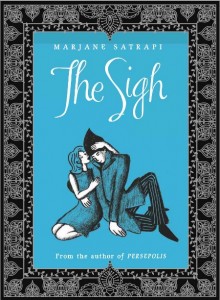
has started coming out (and paying off). Archaia, to the surprise of many, including The Comics Reporter, has announced the November release of Marjane Satrapi’s illustrated book The Sigh, a sweet and somewhat pscyhoanalytical fairy tale mash-up. This was a fun translation for me, and the first time I’ve worked on Satrapi.

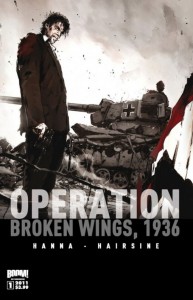
Thanks to Trevor Hairsine’s art, The Comics Reporter and CBR’s Robot 6 picked up on another book I translated in August, The Kaiser’s Legacy. Written by Hérik Hanna, the book is one of several in a Delcourt collection called The Heist: unrelated one-shots that all revolve around heists. BOOM! Studios has retitled the book Broken Wings for its American release.

These are only the first two of many. I was, with the help of my significant other, a veritable factory this summer, and churned out 14 graphic novel translations. Updates will follow.

Listen Up!

September 30th, 2011 § 0 comments § permalink

Some fine spec fic this week for your auditory delight:

  • Nicole Taylor’s story “Ashes” is live in Issue 68 of Bound Off, a monthly literary audio magazine, read in the dulcet tones of the author herself. It starts at 7:18 of a 15 minute podcast. 8 minutes could change your life. You could feel… reborn.
  • My translation of Thomas Owen’s “Kavar the Rat” is live in Issue 249 of Pseudopod, the horror short fiction podcast, read by Ideomancer editor David Rees-Thomas. It’s sad, sweet, curious, twisted, macabre, and just a tad perverted. Why not drop by the forums and leave a little note to tell us what you thought of it?