January 23rd, 2014 § § permalink
The January 15th Washington Post sports Michael Dirda’s review of two Wakefield titles, Jean Ferry’s The Conductor and Other Tales, translated by yours truly, and Pierre Mac Orlan’s A Handbook for the Perfect Adventurer, translated by Napoleon Jeffries.
The Pulitzer prize-winning Dirda is one of our country’s most perceptive and dedicated critics when it comes to fantastical work… and one of the few English speakers ever to write on Ferry outside of a ‘Pataphysics or Rousselian context. I had recourse to his essay “Frank Confessions” while composing my introduction to the Ferry collection, which I am immensely proud to state that Mr. Dirda qualifies as “excellent.” Calling Ferry’s very short stories “Scrumptious Petites Frites,” Mr. Dirda also says:
Big, ambitious works tend to get all the ink and attention, but smaller books, sometimes consisting of little more than charm and idiosyncrasy, are often the ones we come to love. I opened “The Conductor and Other Tales,†by Jean Ferry, and found myself, to use one of those no-no words among serious reviewers, enchanted. In tone and subject matter, these two dozen very short stories may remind you of Italo Calvino or Steven Millhauser at their most beguiling.
January 21st, 2014 § § permalink
My wife writer Nicole M. Taylor and I were guests of the Portuguese Artists Colony on Sunday, January 5, at San Francisco’s Make-Out Room, part of an event called Victimless.
Nicole was there because in November, she won their Live Writing competition, which works like this: Attendees vote on a prompt as they enter the show, and four writers write on the winning topic while the audience watches them sweat, swear, and get inspired. Each writer will read what he/she wrote, and the audience votes on which piece they’d like to see developed into a finished story/poem/rant to be read at the next performance.
I was there because I was one of this time’s Live Writers, along with Carolyn Cooke, Ira Marlowe, and Lori Savageau, who won. I didn’t do the household proud like Nicole, but I did get to listen to folky musical duo Girl Named T warble while I sweated, swore, and got somewhat inspired onstage.
Other readers that evening included Tom Barbash, Maisha Z. Johnson, and founder Caitlin Myer, who called on surprise guests to help her in a polyphonically staged reading of Ted Bundy in prison.
The Make-Out Room’s disco ball presided over all, almost undersea amidst the kelp forests of tinsel and silver ribbon. It was a festive and convivial occasion.
January 19th, 2014 § § permalink
Tireless comics agent Nicolas Grivel drops my name in his state-of-the-union on French comics in the U.S. at Publishers Weekly.
Nicolas, un grand merci!
January 17th, 2014 § § permalink

The good folks at Asymptote were kind enough to kick off their new blog series of mini-interviews with translators—dubbed the “Lydia Davis†Questionnaire, in answer to the perennial “Proust Questionnaireâ€â€”with yours truly. Had a lot of fun.
Asymptote really is a terrific up-and-coming online mag for world lit.
Thanks, Asymptote!
January 15th, 2014 § § permalink
Jean Ferry’s The Conductor and Other Tales is picking up steam again after a holiday lull following its November release:
A book of crazily inventive short-prose narratives with the imaginative zeal of Borges or Breton – first published in France in 1950.
- Gabriel Blackwell, erstwhile editor of The Collagist, excerpts a favorite bit at his site.
- Look I Have Opinions weighs in on my translation of Ferry’s most famous story, “Le tigre urbain†as “The Society Tiger,†previously translated as “The Fashionable Tiger†and “The Urbane Tiger.â€
I like “society tiger†as a translation of “tigre mondain.†I don’t know French well but “mondain†seems to come from a root meaning “the world†and to suggest high society. In contemporary English a fashionable tiger sounds like it means a well-dressed tiger, without connoting much about social class or status.
Sir, I concur.
I’ve made a page in the left sidebar for Ferry with info, quotes from reviews, and links to pieces available online. More, bigger Ferry news in the offing, but I must keep mum for the moment.
January 13th, 2014 § § permalink
The estimable Brazos Price, Atlanta librarian, has these fine words and more to say about Frederik Peeters’ Pachyderme at Cleaver Magazine:
So, Pachyderme is clearly about one woman coming to grips with her life. Or it is a Freudian look at the sublimation of desire. Or it is a treatise on post WWII paranoia. Or it is the exorcism of guilt. Really, though, what this comic is about is not important. Pachyderme is dense. It is cinematic. It sticks with you, it makes you think about it long after you’ve read/watched it. You may want to re-read it, to re-interpret it. Perhaps you will even dream on it.
Thank you, Mr. Price!
December 15th, 2013 § § permalink
Rick Kleffel is a very, very awesome guy. Or in this case, I should say, Ferry, Ferry awesome! One of the hardest-working, most indefatigable voices in indie coverage of fiction—spec and more—he rolls in the very very first review of my latest full-length prose translation, Jean Ferry’s The Conductor and Other Tales, at his site The Agony Column:
Ferry’s prose pieces are short and often embrace a tart spirit of self-contradiction. He’ll et the reader up with an lavish and sometimes graphic description of a place or an event; a trip to Easter Island — and then deny the truth of what he’s written. He makes it real for the reader, then suggests it is not. Of course, where the lies begin and end is the question, and the import of the something being “true” as well. Ferry’s stories reflect a deep and thoughtful conception of the reading experience, and he uses this to a degree as a plot point…
This is a perfect one-a-day antidote for reality in all its clunky, gory glory. Consider these seeds, prose to be planted in your mind and left to grow very, very wild in the fertile soil of your unconscious life. It’s possible the best effects of reading this book may not be accessible to conscious thought.
Kleffel continues his coverage with a podcast interview. It was a thrill to be quizzed by such an insightful and perceptive reader; in typical esprit d’escalier fashion, my mind was predictably buzzing with add-ons, caveats, and quips hours after the interview. Excerpts from the interview were also broadcast on KUSP’s 88.9 Central Coast Public Radio (6-7 PM PST, December 8th). On Rick’s show there, I had the huge honor of joining Susan Stinson, Jeff VanderMeer, and Jonathan Lethem.
Thank you, Rick!!!
December 13th, 2013 § § permalink
From the minds that brought you
now comes an exciting new venture in literary magazines:
After five amazing issues that took The Coffin Factory from newbies to playas overnight–seriously, the ground these guys have covered, it’s like they were wearing seven-league boots–the Coffin folks are changing the name of their estimable publication and relaunching it as Tweed’s magazine of literature & art. The goal: to embrace a larger audience of readers, writers, and artists.
I mean, The Coffin Factory featured: Noam Chomsky, John Banville, T.C. Boyle, Joyce Carol Oates, Aimee Bender, Lydia Davis, Bonnie Nadzam, Charles Simic, Roberto Bolaño, José Saramago, Jorge Luis Borges, Enrique Vila-Matas, Andrés Neuman, Jean Ferry, László Krasznahorkai, César Aira, Bernard Quiriny, Milan Kundera, Rabindranath Tagore, Maurice Pons, Edith Grossman, Natasha Wimmer, Katherine Silver, Margaret Jull Costa, Linda Asher… and that’s just the writers. Don’t get me started on the artists!
All this without any corporate backers or funding fairy godmothers!
But now they need your help. Tweed’s is running an Indiegogo fundraising campaign to help launch the new magazine and are asking for your support with this independent artistic project.
Please visit Â
our Indiegogo page  to learn more aboutÂ
Tweed’s and
  why we’re making the switch. And while you’re there, browse our irresistible selection of perks, including book bundles from our favorite publishers, autographed copies of magazines by contributors, signed books, tote bags, flasks, notebooks, and more.
Who’s already in Tweed’s? Edwidge Danticat, John Freeman, and Sjón will be in the first issue, which we plan to release to bookstores nationwide in March, once the Indiegogo campaign has concluded.Â
December 11th, 2013 § § permalink
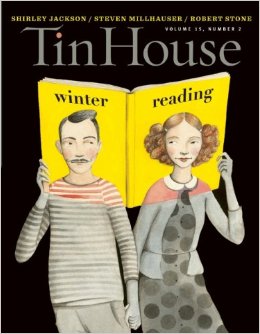
Looking to cozy up in a comfy chair with a good story? Now out in Tin House #58, their annual Winter Reading issue, is Belgian fabulist Paul Willem’s tale “The Cathedral of Mist,” in amazing company with fiction by Steven Millhauser and Shirley Jackson, an interview with Robert Stone, and Rachel Monroe’s appreciation of May Sarton!!
Here’s an excerpt from the story, which is available in is entirety online:
One day the architect V., who was very well-known in Belgium before the First World War, grew tired of concrete and began to hate granite. He had noticed that no matter what one did, stone was stone. Stubborn, it fulfilled only its destiny, which was to endure. It focused its immense, compact strength inward, on itself. And pitted all its inertia against those who tried to distract it by moving or carving it. It loathed the verve church spires lent it. It abhorred all winged things. It suffered in the wind. And should one raise it to a temple pediment, it seized every chance it had to return to the earth. That is why columns topple and even the most lasting monuments slowly sink into the soil, where stone reunites with its beloved darkness.
The architect V. renounced the use of stone. After years of meditation, he built a cathedral of mist.
Willems (1912-1997) belongs to the final generation of great Francophone Belgian fantasists of Flemish descent. He published his first novel, Everything Here is Real, in 1941. Three more novels and two story collections from his later days bracket his career as a playwright, for which he was best known in his lifetime. Donald Friedman’s translation of his late novella The Drowned Land was nominated for the Dublin IMPAC Literary Award and published with Suzanne Burgoyne’s translation of his play La Vita Brève in an edition from Peter Lang in 1994. I have published his work in
- Tin House #50: “The Horse’s Eye†(not available online)
- Subtropics #13: “Cherepishâ€Â (not available online)
- Scheherezade’s Bequest #15: “The Colors of the Worldâ€
December 9th, 2013 § § permalink
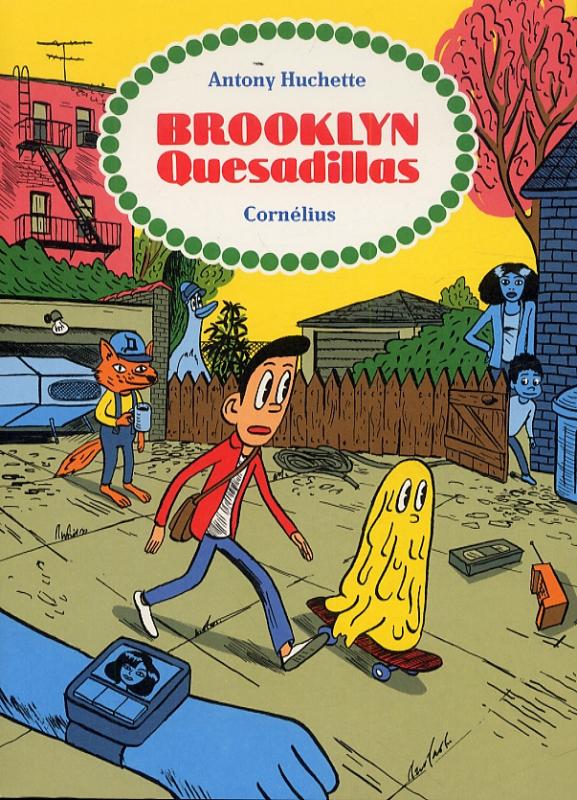
Now out from Canadian indie Conundrum Press, a quirky little title I worked on over the summer: Antony Huchette’s Brooklyn Quesadillas! If you’ve ever wanted to see a man turn benignly into sentient melted cheese, watch a TV show hosted by a coffeepot, or wondered where forgotten sitcom lovelies from the ’80s live, forever young (hint: an island off Manhattan, with their rejuvenating baths), then this is the book for you.
This English edition w be launched at Comic Art Brooklyn, November 9, 2013. Check the blog for more event details.
Quesadillas is the second book in the enterprising Conundrum’s International Imprint, after Chihoi’s The Library.
Huchette is a French artist and animator who makes his home in Brooklyn. He is also a musician and DJ. His previous book is La marée haute (6 Pieds sous terre). Brooklyn Quesadillas was published in French by Cornelius and this translation represents his first work in English.