Bernard Quiriny: Une collection très particuliere

July 2nd, 2012 § 4 comments § permalink

“For some time now, distances have been increasing: all other things being equal, each day streets grow longer, suburbs farther from downtown, apartment complexes farther apart.” With these words, Bernard Quiriny begins his chapter “Deglomeration,” the fifth in a category entitled “Our Era.” The Belgian fabulist’s latest book, which I hesitate to describe as a story collection, is divided into three such categories, the other two being “Ten Cities” and “A Very Curious Collection,” which lends its name to the book as a whole.

“Ten Cities” is exactly that: ten brief, fanciful descriptions of cities real and imagined, or imagined aspects of real cities, from around the world (with the exception of Asia and Africa), sometimes narrated by the author’s recurrent character, Pierre Gould, and at other times presented as personal experience. More often than not they take the form of recounted travelogues or unattributed, guidebook-style information. They range in length from a single, two-line sentence to six or seven pages.

The entries in “A Very Curious Collection,” each thematically titled, are all presented by Gould, as he introduces the narrator to another section of his unique library. These sections, each containing one kind of book (and usually its opposite), are as eclectic as they are whimsical: books their authors have forgotten they wrote (and books authors wish they could forget, and books that are forgettable altogether); the most boring books ever written (both intentionally and not); puzzle novels (Russian nesting novels, recombinatory novels) always containing more than they appear to; books authors have tried to disown or destroy (including a notebook of Gould’s containing a novel he rejected before he ever finishing it); books impossible to read except in formal attire; specialized cookbooks (recipes for stomach trouble, recipes for skin reactions, impossible recipes); books that continue to correct themselves, quietly pursuing their revision toward perfect economy (which also means they grow shorter); books that have saved lives (and taken them); books that can act as batteries and power lamps; books that have swallowed their authors, who keep writing them from within; books like yard sales full of bric-a-brac, redeemed and made endearing by an unexpected find.

As for “Our Era,” these observations on new phenomena and their effect on contemporary society range from mass resurrections, cross-gender bodyswapping, and willful name-changing to youth serums and an infiniverse of parallel realities being created every minute by every act, no matter how insignificant.

If I seem, with these categories, to have described a book so wonderful it cannot possibly exist, that is at least partly true. A fan of the author’s work, I looked forward to this book and ultimately wanted to like it more than I did. It plays like the trailer of an impossibly good movie that, alas, we will never see, because it does not exist. And so A Very Curious Collection is by turns intriguing, exasperating, brilliant, titillating, dilettantish, cavalier, but always elusive, ever pointing outward to something greater than the sum of the disparate parts it leaves you with. Its ideas are often as half-baked as they are arresting, at worst dashed-off, at best reflecting the wit, fun, and exuberance of Quiriny’s restless experimentation, lab notes from his mad lab. There are no real standalone stories in this book; rather, the closest American market category of writing to Quiriny’s is the upscale humor essay, which often departs from a whimsical premise. Quiriny, whose targets for affectionate satire are taken less from real life than from other books, is something like a feuilletoniste of experimental literature. His satire is hit or miss, buoyed along by his nonstop invention; the real trouble is that by failing or refusing to follow up on his ideas, he has made few of them memorable.

Nevertheless, there are moments of genius. “Deglomeration,” the gradual spatial expansion of the world, begins with a hand reaching out to snooze an alarm clock and missing, “the nightstand having retreated five inches in the night.” A garage grows to the size of a tennis court. Rooms suddenly larger are partitioned into smaller ones.

That it takes increasingly longer to get anywhere reflects something of the world we know: transport that once made the world smaller is subject to congestion and delays, cities recover some of their scale when foot traffic becomes the main means of locomotion. Things seem farther apart again; Quiriny has merely literalized this experience in geography. When the distance between Concorde and Charles-de-Gaulle lengthens, more metro stops pop miraculously up to divvy up the distance into more customary intervals.

And yet, Quiriny is careful to note, “Strangely, this transformation is not accompanied by any creation of new matter. From space, the Earth does not seem to grow: photos prove this.” He returns to tweak reality on the level of absurd mundane detail at which he excels. Fields for sporting events must be redrawn before each game; delivering food amounts to a cross-country rally; real estate is a wiser investment than ever, since houses grow along with their families. Ireland, Japan, and Australia are largely unaffected. England and Scotland are among the slowest growers.

Soon, Quiriny’s narrator reflects, “we will each wind up alone on our own vast stretch of land, growing farther every day from everyone else’s.” Which is as fine a metaphor as I’ve found for the isolation, the loss of community, contemporary critics blame on our increasing ability to select and filter what we receive from our environments (usually media). “Once, visionaries believe the human race, its numbers growing every day, would have to leave Earth and colonize another planet. They were wrong: in reality, all you have to do is walk a little ways to find immense virgin spaces where you can found your own personal kingdom.” Inner space; the literalization of the virtual.

Quiriny finishes by acknowledging the temporal aspect of the experience he has literalized in physical space with a joke I find oddly moving. A remix of the classic Verne novel has become a bestseller: Around the World in Eighty Years, in which it takes three generations, grandfather to grandson, to round the globe, a feat as monumental as building a cathedral. That took a village too, though not a global one.


Titles in Translation from Archaia

July 1st, 2012 § 0 comments § permalink

Siegfried: Alex Alice brings bravura Disney animation-style art and epic sweep to his retelling of the Ring Cycle. This first volume is followed by an interview and many sketches.

Genetiks: Prolific French scripter Richard Maranzano spins a near-future SF tale of corporate intrigue, intellectual property, and biological experiments. The scope of the frame story remains mysterious in this first volume. Jean-Michel Ponzio’s photo-based style is reminiscent of Alex Maleev.

The Grand Duke: Former aviation draftsman Romain Hugault brings his meticulously detailed knowledge of planes to this story of WWII aces on the bitter Eastern front, based on historical figures. His illustrations are a labor of love and accuracy. Writer Yann creates a memorably nihilistic one-eyed Nazi commandant with a Totenkopf cane.

Cyclops: The series kicked off by Killer creators Matz and Jacamon continues with art by Gael de Meyere. In the future, private armies provide peacekeeping forces around the globe, their televised battles are the most popular reality show.

Happy reading!

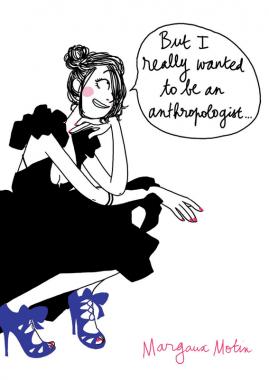
But I Really Wanted to be an Anthropologist: Margaux Motin

June 29th, 2012 § 0 comments § permalink

So this graphic memoir came out last month. Memoir… though it’s autobiographical, and covers a roughly contained stretch of time, it’s more a collection of one- or two-page gags strips. Margaux Motin, a freelance Parisian illustrator and cartoonist, excels at this sort of personal humor. Usually named, along with Penelope Bagieu and Nine Antico as the up-and-coming girl stars of graphic fiction, she’s an absolute champ at drawing herself, or her cartoon persona, whom Teddy Jamieson, in The Glasgow Herald, called “a dirty-minded, potty-mouthed, thong-flaunting… Posy Simmonds,” while Hillary Brown, in Paste Magazine, called her an unlikely combination of “Cathy and Lewis Trondheim…  a French Jenny McCarthy (gleefully vulgar… while committed… to presenting herself as an object of desire),” noting  her drawings have “plenty of charm.” Sexy, self-mocking, high-maintenance but mindful of it, her cartoon alter ego has that sort of dashed-off look some women aspire to in real life: an artful muss or casual dishevelment that actually took hours of careful strategizing. Motin’s fluid line conveys a sort of Feifferesque nervous urban jazziness. She’s also terrific at expressions. In what I hope will be a compliment to her, it reminded me of Marcos Chin’s posters for the dating site Lavalife. In what will definitely date my Manhattan days, I remember always seeing these in subway cars.

Anthropologist isn’t exactly Sex and the City: Paris Edition, laced as it is with more humor about dealing with a kid daughter. This is the first time I’ve ever done anything remotely chick-lit, and it was a fun experience, delving into the different vocabulary, finding cultural equivalents, and trying to give the jokes the same snap and tang as in the French. The Publishers Weekly review is quite complimentary, and gives a great sense of the book:

French blogger and illustrator Motin makes her English-language debut in this funny and fresh translation of her first graphic novel. Originally published in France in 2009, the book collects largely stand-alone cartoons in the style of Motin’s blog. Fashion-obsessed, self-employed artist Motin is the mother of a toddler (“the tyrant”), has a tense relationship with her mother, and is married to a man who provides equal opportunities to be the butt of the joke—and to turn the joke back around on Motin. The humor translates brilliantly because her self-mockery is in exactly the right tone to make readers rejoice in her small victories. Several of the anecdotes are also reminiscent of comedies where adults who have responsibilities sometimes still act like they did when they were in college, with funny and revealing results. Motin’s cartoonish illustrations and her use of color for effect rather than realism create a whimsical tone and bolster her already comedic antics. A great choice for a beach read—or a guilty pleasure.

Motin’s a popular cartoon-blogger (you can get a sense of her , and some kind reviews on Goodreads and Stumptown have called for more of her work to be translated. I’m game!

This fall in Seattle

June 27th, 2012 § 0 comments § permalink

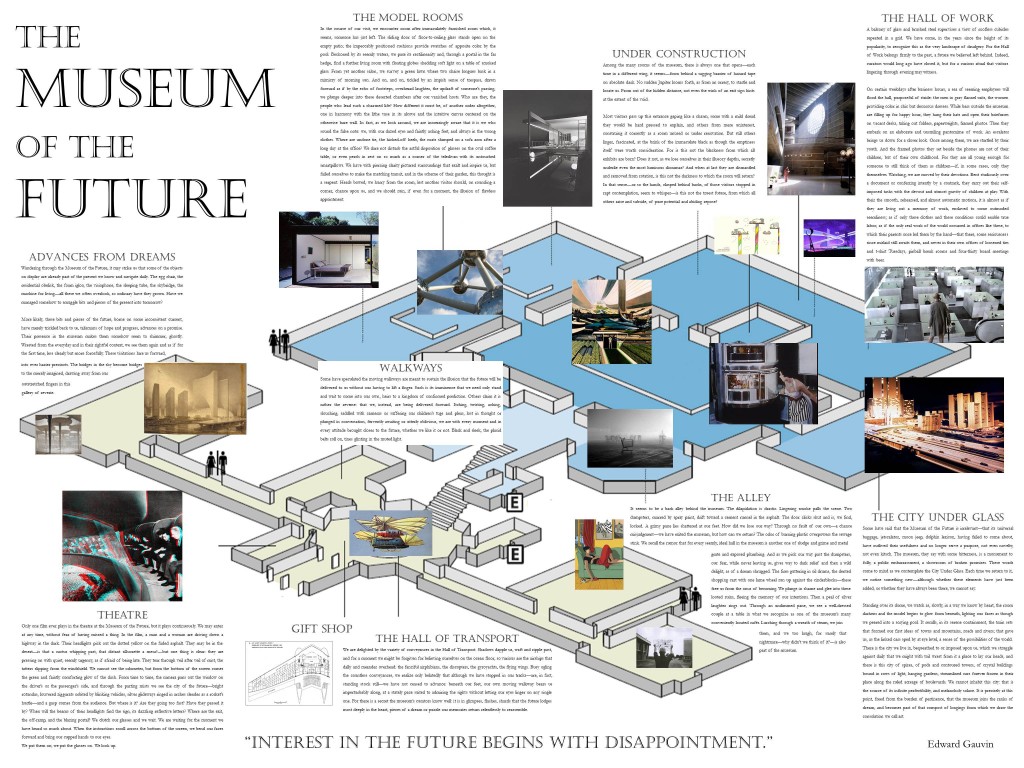
at the Pacific Ancient and Modern Languages Association’s annual conference, I’ll be presenting “The Museum of the Future” on an experimental fiction panel chaired by Sean Bernard, Associate Professor of Writing at the University of La Verne. The other panelists will be Joshua Jensen of Claremont Graduate University, presenting on the fiction of William T. Vollmann and Ben Marcus; Michael Miller of the University of Louisville, presenting on Tom McCarthy; and my fellow USC fiction writer Bryan Hurt, whose paper “Nature Has Cramped the Imagination: Experimental Fiction in the 18th Century” will examine “a time credited as the ‘birthplace’ of both novel and experimental science” to show that “fiction and experiment are deeply intertwined.”
The conference runs at Seattle University from October 19-21.

Best of Enemies

June 25th, 2012 § 0 comments § permalink

Last fall I voiced my excitement at getting to work on my first David B. graphic novel, Best of Enemies. The first volume of a history of relations between the Middle East, it’s co-scripted by Islamic scholar Jean-Pierre Filiu, and covers the period from 1783 to 1953. It came out last month from Self-Made Hero! Check it out!

Douglas Wolk covers it in a Sunday New York Times comics roundup, where he also covers in capsule form two other foreign titles—Guy Delisle’s Jerusalem, from Drawn & Quarterly, and Kiki de Montparnasse by Catel Muller and Jose-Luis Bocquet, also from Self-Made Hero—like many reviewers, neglecting in all three cases to mention that these books were translated (by Helge Dascher and Nora Mahony, respectively).

A Few Notes on Sleep

June 24th, 2012 § 0 comments § permalink

“Sleep is the enterprise all society fights most fiercely, second only to love. Seeing a sleeper irritates a man, reminds him that he too is a sleeper, and that before twelve hours are up, he too will succumb.”

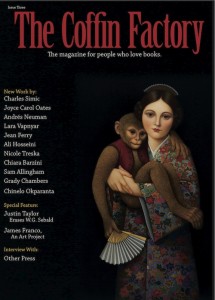
The latest issue of The Coffin Factory—the third for this august up-and-comer!—features Jean Ferry’s solemn yet witty consideration of sleep, “On the Frontiers of Plaster”. Readers may remember Ferry’s short story, “The Society Tiger,” from the same 1953 collection (The Engineer) featured last fall at Weird Fiction Review.

More Stories in Translation

June 19th, 2012 § 0 comments § permalink

  • Exquisite Belgian fabulist Paul Willems, whom I’ve published in Subtropics and Tin House, is online in the latest issue of Scheherezade’s Bequest (#15) with the elegant and fairly traditional fairy tale, “The Colors of the World”. The story was first collected in The Delft Vase (Le Cri, 2004).
  • Pseudopod has Pete Milan delectably reading Belgian horrormeister Thomas Owen’s “The Women Who Watch,” first published last April in the inaugural issue of The Dr. T.J. Eckleburg Review. Like it? Join the discussion in the forums!
  • Big Pulp’s Summer 2012 issue features a blackly hilarious piece by contemporary Belgian chronicler Thomas Gunzig.  The unclassifiable, irrepressible Gunzig took Belgium’s top literary prize, the Prix Rossel, for his 2001 novel Mort d’un parfait bilingue; his most recent novel is the slasher homage and parody 10,000 Liters of Pure Horror (Diable Vauvert, 2007). The son of a noted cosmologist, he is known for his dark humor, absurdism, and the time he challenged editor Luc Pire, a Tae Kwon Do red belt, to a duel at the Brussels Book Fair over the rights to one of his own story collections. He won.
  • And finally, in April I helped the New York Times cover the runup to the French elections with “Voting for Yesterday in France.”

Châteaureynaud News

June 18th, 2012 § 1 comment § permalink

Back after a long hiatus with good tidings for Anglophone fans of French fabulist Georges-Olivier Châteaureynaud:

1) G.-O.’s story “Icarus Saved from the Skies,” first published in the July-August 2009 issue of F&SF, was selected by editors David Hartwell and Kathryn Cramer for inclusion in their Year’s Best Fantasy 10 forthcoming from Tor. It is included in the Small Beer collection A Life on Paper.

2) G.-O.’s story “Final Residence” appears in the latest, Summer 2012 issue (#14) of Subtropics, the University of Florida’s literary revue, helmed by the amazing David Leavitt. This is the longest G.-O. story I’ve translated to date, and one of his most recent to appear, anchoring a 2011 chapbook that it lent its title to, Dernière residence (Christine Bini’s insightful review here in French). Each story in this triptych examines that cultural phenomenon, the writing residency, through G.-O.’s usual skewed and haunting lens, featuring sphinxes, creatures that come out of a mirror, and perhaps scariest of all, ruminations on posterity…

3) The esteemed jury of Dale Knickerbocker (Chair); Kari Maund, Abhijit Gupta, Hiroko Chiba, Stefan Ekman, Ekaterina Sedia, Felice Beneduce, and Irma Hirsjärvi have seen fit to shortlist my translation of G.-O.’s story “Paradiso” in the short form category of this year’s Science Fiction and Fantasy Translation Awards. The 1974 story (composed in Capri and Paris), from 1976 collection The Beautiful Coalwoman, is not available in the Small Beer collection A Life on Paper, but can be read online at Liquid Imagination, where the translation first appeared last summer.

The SFFT Awards, that estimable endeavor we all hope will become a venerable institution, is at the forefront of an Anglophone attempt to truly globalize speculative fiction. Further evidence of this trend? Look no farther than the panel moderated at this year’s Wiscon by YA writer and Clarion grad Emily Jiang:

Reading, Viewing, and Critiquing Science Fiction

2011 saw the first ever Science Fiction and Fantasy Translation Awards. Let’s discuss the winners, the state of F&SF translation (who gets translated? into and from which languages? how interested are publishers? does anybody actually get paid for translating this stuff?), and efforts to encourage a world consciousness in the SF community (like the VanderMeers’ Weird Fiction Review). We’ll also cover where readers can go to discover F&SF in translation.

Let us hope readers’ curiosity and enthusiasm turns internationalism into a groundswell.

I’ll Be Presenting

April 4th, 2012 § 0 comments § permalink

my poster version of “The Museum of the Future” today at noon on the USC campus in the Von Kleinsmid Center courtyard, as part of the Fourth Annual Graduate Poster Symposium. The courtyard is packed with posters detailing fascinating research from all disciplines, available for perusal all day long. Drop by and say hi!

…aaaand we’re back!

April 2nd, 2012 § 0 comments § permalink

after a long absence, with links a-plenty to report, evidence of activity for the missing months.

  1. “Europe’s Austerity Mirage” by Jean-Paul Fitoussi, 2/29
  2. “A Boy to Be Sacrified” by Abdellah Taia, 3/25