Two Strips I Like

March 24th, 2010 § 0 comments § permalink

Up at WWB this month (and in virtual perpetuity), Jamie Richards’ translation of Baudelaire, The Metaphysical Ostrich, by Marco Arnaudo and Paolo Di Tonno.

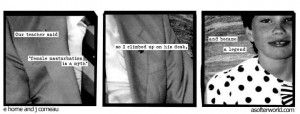
And A Softer World by Emily Horne (pictures) and Joey Comeau (words), a strip two friends introduced me to almost simultaneously, though it is of long standing, and I am later to the party than is fashionable. But I liked it enough that it made me pick up Comeau’s book, Overqualified, about which I have so many good things to say that I will limit myself to them, instead of picking nits. Let’s just say it’s what I thought A Heartbreaking Work of Staggering Genius would be when I first heard about that book, but much better, because it has fewer words. For as Roland Jaccard reminds us, “Few know that not writing is also the fruit of long, arduous labor. It requires a force of character those who write do not have. Besides, is writing anything at all but a small, unimportant misunderstanding?”

Clarion 2009: World Domination One Story at a Time

March 23rd, 2010 § 3 comments § permalink

Some long overdue congratulations to friends from my Clarion class. They’ve been published! Go read them!

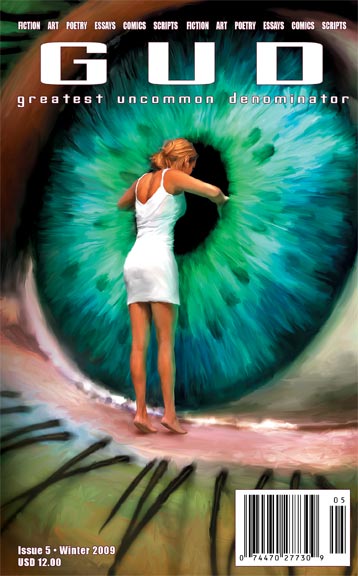
Kenneth Schneyer’s story “Liza’s Home” appears in the latest issue of GUD, pictured above.

Shauna Roberts’ “The Hunt” is up at Jim Baen’s Universe.

Liz Argall’s “Cracked Leather” is available in its entirety at The Pedestal Magazine.

As is Nicholas Bede Stenner’s “Lily Can’t See Men” at Joyland (Vancouver). We had the pleasure of workshopping these last two stories last summer.

Matt London’s “Mouja”  is forthcoming in J.J. Adams’ anthology The Living Dead 2.

Tiffani Angus’ “If Wishes Were Horses,” at Strange Horizons makes the British Fantasy Awards 2010 longlist.

There’s more news but it can’t break yet. » Read the rest of this entry «

I Have ARCs

March 22nd, 2010 § 1 comment § permalink

Out May 25!

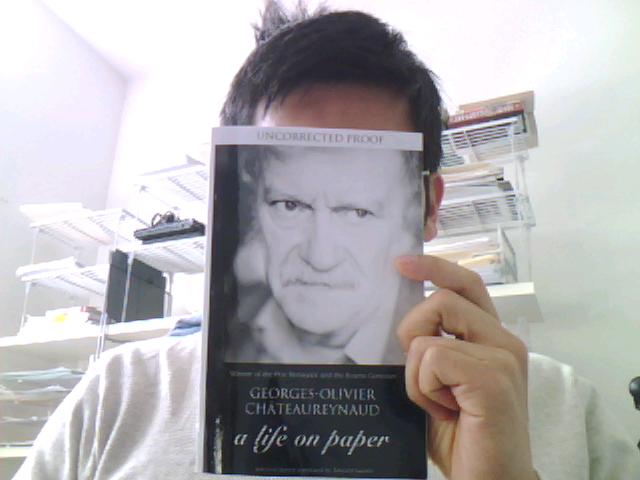
Georges-Olivier Châteaureynaud's A Life on Paper

OK, so… not quite Magritte. But I did resist altering a kitten photo and spelling “Have” as “Hazz.”

Now I can be pretentious and ride around on public transport reading a book I had a hand in (Small Beer Press has graciously given me a cover credit). In fact, I will be doing so, while preparing an essay on the author. Having a bound copy in hand is such a pleasant way to review one’s work. Hence the “R” in ARC, I suppose.

And two new recent Châteaureynaud acceptances have joined the Châteaureynaud Central page: I’m proud to report “The Excursion” will feature in Joyland (San Francisco) in May, and “Another Story” will be appearing in the summer issue of The Southern Review.

Meanwhile, if you read French you might want to check out the author’s new novel, Le corps de l’autre, now out in France, as well as the first book-length critical study of his work, Christine Bini’s Le marbre et la brume.

Terror… or Horror?

March 5th, 2010 § 0 comments § permalink

Author Joe Hill, in the Onion AV Club interview for Horns: “Terror is the desire to save your own ass, but horror is rooted in sympathy.”

Critic John Clute, in the Strange Horizons review of the two-volume Library of America’s American Fantastic Tales, edited by Peter Straub:  “I might still mildly suggest that volume one is given over mostly to discovery, which is Terror, and that volume two focuses more on experience, which is Horror…  we near the end of terror. We begin to enter horror.”

Bernard Quiriny in Subtropics 9

March 2nd, 2010 § 0 comments § permalink

Cover Image

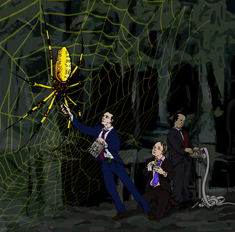
Cover Image: Golden Orb Weaver and Her Translators by Scott R. Horsley, 2009

The latest issue of Subtropics is now available for purchase and perusal online and in print (at discerning periodical purveyors nationwide), featuring my translation of Belgian Bernard Quiriny’s “A Guide to Famous Stabbings” from his debut collection Fear of the First Line (Phebus, 2005). The entire story is also available online at the journal’s website, where you’ll also find in English and the original French an interview the author graciously agreed to give, wherein he muses on sundry topics of interest including author Enrique Vila-Matas, the writing process, other stories and characters from the collection, what it means to be a Belgian Francophone writer, and the Belgian fantastical tradition known as the Belgian School of the Bizarre.

Comments welcome from any and all readers, who may wonder on the basis of this story that I characterize Quiriny as a fabulist. Without referring to other stories that would vindicate the appellation beyond doubt, I would say only this: Borges ventures that “at least one of the following four elements must be present in a narrative for it to be fantastic: 1) contamination of reality by dream, 2) a work of art within a work of art, 3) travel in time rather than in space, and 4) the presence of a doppelganger.”

In Other News of Superfluity,

March 1st, 2010 § 1 comment § permalink

I live in a world preparing to release upon hordes palpitating with sweaty-palmed anticipation this summer a remake of The Tap Dance Karate Kid starring Will Smith’s son: set in China, despite the misleading titular martial art, with Chinese kids instead of Cobra Kai, and featuring Jackie Chan in the role formerly made famous by Pat “Happy Days” Morita. A small step for Jackie, but surely a giant step for race relations, especially with our brothers from another sensei. Plus ça change…

At this point all members of the target audience wishing to protest but it might be good, whose parents weren’t even having unprotected sex yet (aw, it was the early ’80s. Who wasn’t having unprotected sex?) when the Ralph Macchio original came out, should shut up, grasshopper and listen to their elders, who were all in third grade when this movie made them go and take karate classes with a bearded man named Sensei Stan at their local YMCA, which they can remember being driven to on Saturday mornings pointless with rain. Or maybe they did this because their parents hadn’t let them see this movie they’d heard about from all their friends. They can remember the smell of the rain and the smell of the station wagon backseat and the smell of the gym when they walked in, chilly in an overstarched gi fastened by the orange belt a few months of katas and faithful attendance had earned them, which kept coming undone even though they’d knotted it tightly as they could. » Read the rest of this entry «

In Case You Were Wondering (Though You Weren’t)

February 28th, 2010 § 5 comments § permalink

Sometimes people ask me: what do you do all day long as a freelancer?

Actually, no one ever asks me that, though I wish the cute girl at the far end of the bar would. (The universal, hypothetical cute girl, of course—a figure more rhetorical than gorgeous, made less for romance than the purposes of argument—in the bar I rarely actually go out to.) Most people hear I’m a freelancer and, aside from the standard envious comment about how nice it must be to work from home, are generally content to leave it at that. On the rare occasion when they do press further, I unfailingly find whatever account of I give of how I spend my time comes out sounding inadequate, much as ledgers fudged to hide fraud look in a court of law.

Which is not to say I haven’t clear memories of fiendishly productive days as a freelancer, days best characterized by dispatch and alacrity, in which tasks were no sooner started than successfully wrapped up, but that any honest appraisal sees these days for the exception they are, rather than the rule I wish they were.

Such that the question of how I spend my days is, really, the kind of question I’m always asking myself, from the moment I, an esprit descending an escalier, leave the bar, to those moments between tasks when hands stop their puttering and a space suddenly opens for reflection on action (“What am I doing?”). It is the kind of question a perennially guilty conscience, wishing to dispel the misplaced envy of people convinced freelancing is a breeze, is always putting to me (“No, you see, but it’s really—”). It is the kind of question that hits you when, leaning back in your chair for a stretch and a yawn, you see dusk has crept up on you already, and the impression of not having done a thing truly useful and fulfilling is as certain as the impression of having been busy every minute: for where, where has the day gone? » Read the rest of this entry «
Not surprisingly, the ability to lie effectively

February 21st, 2010 § 0 comments § permalink

doesn’t come to most of us before the age of five, when the sense of an internal self has begun to take root. Lying in this context becomes a measure of sophistication: to make a lie believable the liar must understand the mind of the person he is deceiving. In an experiment that Gopnik cites, children are shown a closed box and told that there is a toy inside. But they mustn’t look for themselves. The experimenter leaves the room and naturally the children peek in the box. When the experimenter returns the three-year-olds insist that they haven’t looked in the box and in the same breath tell the experimenter what was in it. Five-year-olds, however, are able to carry off the deception…

This chasm between the perceptions of three-year-olds and five-year-olds reveals a great deal about how children’s consciousness changes as they develop a sense of personal, autobiographical memory and consecutive time. Prior to the age of five, children appear to experience time in a different manner. They are perfectly capable of ‘forgetting’ events that they experienced a minute ago, as well as their mental state when the experience occurred. They seem to think associatively, closer perhaps to the hypnagogic state that one drifts into just before falling asleep, than to one that is ordered around a timeline with a past, present, and future.

~ Michael Greenberg, “What Babies Know and We Don’t” (review of Alison Gopnik’s The Philosophical Baby in NYRB)

Chicomoztoc, The Place of the Seven Caves

February 15th, 2010 § 0 comments § permalink

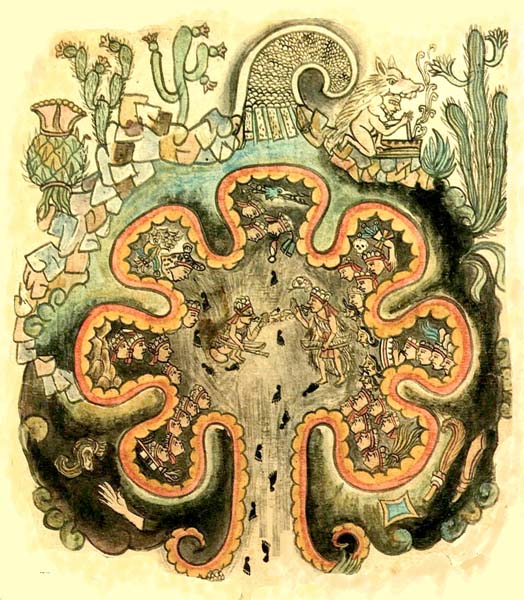
The mythical origin of the “nahuatlaca” tribes. From the “Historia Tolteca chicimeca”. A postcortesian codex from 1550, written by the people of Cuauhtinchan (of chichimeca ancestry) to sustain their right to their lands, under the Spanish autorities. They wrote their history from A.D. 116 through 1544, using a mixture of European and prehispanic styles. (courtesy Wikipedia)

New Comics Translations Now Live

February 6th, 2010 § 0 comments § permalink

At Words Without Borders, in their annual Graphic Lit issue. Stunning pages by Beirut native Zeina Abirached lend warfare a formalist rigor in an excerpt from her memoir A Game for Swallows.

There’s also a section from That Was Happiness by Blutch, one of France’s leading cartoonists, whose illustrations have appeared in Libération, The New Yorker and Les Inrockuptibles. He was awarded the Grand Prize at the 2009 Angoulême comics festival.

In a subtitled video segment at the WWB blog, the artist discusses influences on the book.