Less than a week

September 19th, 2010 § 0 comments § permalink

in a hotel and already I’ve got mes vieilles habitudes: little rituals, like lines traced in salt or sand, to ward off the chaos of travel. Like the instinct to keep your belongings close, and keep close track of them, vitamins and water and a cell phone in plain sight on the nightstand, your backpack pulled close to your bed. As if it were possible, to establish around your person, a magical perimeter against unpredictability, a place for you and the home you carry with you.

Breakfast begins with eggs—all in one basket, labeled RAW in four languages—at one end of the hot bar (the other items, uniformly unappetizing, are ravioli, the kind of beans Brits put on toast, and pallid, wizened hot dogs standing in for sausage). A little open boiler is chugging away, and you lower the eggs into the water, past the jostling white froth, with a wire holder whose handle folds over the boiler lip. In the time it takes you to find a seat among the hordes of aged German tour groups with your juice, toast, and cereal, your eggs are perfectly soft-boiled. There is one waitress for the whole room, who beelines between clearing tables and taking names at the door. She’s courteous as a matter of course but a darling if you speak French.

The Hotel Astrid, where the Fulbright Commission has put us up for the week of our search for more permanent housing, is on a small downtown “square” called the Place du Samedi (Zaterdagplein). I say “square” because although it is likelier than “plaza” to connote a noncommercial urban public space in English, there is nothing four-sided or regular about it; place is much more amorphous—a glorified intersection, perhaps, with some central point of interest. From my room at the end of the hall I have a slantwise view of a church down the street, with its unscrubbed Baroque façade and a homeless man slumped into his winter jacket,
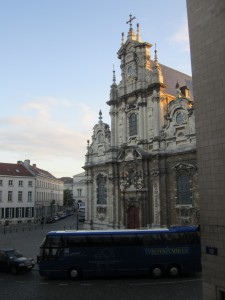
but not of the nearby, much larger cathedral Sainte-Catherine, which lends a name to the equally larger “square” behind, anchoring its near end as it zooms off past blocks of seafood bistros with neon cursive signs toward the bright exclamation of a fountain.
What I hate

September 17th, 2010 § 0 comments § permalink

is when an author, editor, or rightsperson, getting a shrewd look in his or her eye, asks almost rhetorically, “So… you like the fantastic?”

At this point it’s clear they’re about to thrust some book on me, and when inevitably they do, it’s always with the reassurance, “There’s something of the fantastic in this,” but whom, really, are they reassuring? For of course, I am usually being sold a bill of goods. Not to patrol the borders of my chosen field—I’m all for cross-fertilization—perhaps it’s only that I hate, have always hated, having reading foisted on me. Or having my preferences falsely appealed to. I’d rather be told, “Read this because it’s good,” than be lied to about any potential fantastic content.

Were the detailed instructions

September 15th, 2010 § 1 comment § permalink

on the paper towel dispenser in the first floor men’s room at the Ministère de la Communauté Française, replete with arrows for pull direction in the sequential illustrations and suggested usage lengths (± 32 cm), really necessary, or just another example of the Belgian humor that had papered the cafeteria walls with an anti-profanity campaign that, of course, seemed instead like a giant injunction to swear (Tu me fais ch… aud au coeur, Mer… ci de votre comprehension)? Hard to say, but then again, when I went back that afternoon, the paper towel dispenser was broken.

No matter how many foreign towns

September 13th, 2010 § 3 comments § permalink

I’ve been to on my own, the prospect of dinner alone the first night always intimidates me. My grasp of the language, if I do speak it, grows halting, my step on the threshold hesitant. I can’t decide if the eatery I’ve blundered into looks promising or if I’ve made a mistake: but really, it’s neither, just the fear of ordering and thereby confirming what must be obvious from my dress and demeanor: I’m a foreigner. It must be written on my face, the way nerd was when I loitered in the doorway at middle school dances, afraid to go in: into the dimness and the swaying and the crepe paper and the bored chaperones by the soft drinks. What the hell am I doing here? I don’t belong here.

You don’t want to be known—you want to pass as, be taken for—but you will be found out. My solution used to be the anonymity of fast food, served up by dead-eyed, indifferent cashiers, their curiosity extinguished by repetition and exhaustion. My first night in Edinburgh—my first time abroad, fourteen years ago—I wound up in a McDonald’s, sitting and stewing in a defeated embarrassment which, like the fear it had replaced, only I was aware of, even as I took comfort in the food’s familiarity.

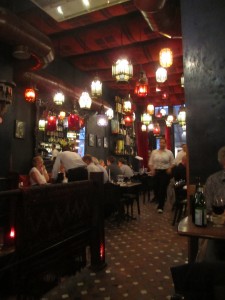
Sunday night at six when I get in the hotel’s dead. I’m not sure why I expected some program coordinator to be on hand, or excited Fulbrighters to be chattering on lobby sofas. I’m the second-to-last to arrive—when the clerk hands me the information packet with my name on it, there’s only one more envelope waiting. I expected, I suppose, something like the first night of a conference: relaxed and informal introductions. Chill, not chilly. I expected us all to be on one floor and maybe one of the doors open, with someone spreading out their info packet on the bed, or some enterprising sort to be going around knocking, sticking a hand out, taking you aback with alpha extroversion. But there’s no bar and the breakfast-only restaurant is dark behind closed doors. After half an hour of strolling, and eyeing prices in the dimming evening, I walk into a warm Moroccan restaurant with many lanterns and low, plush red chairs. A few weeks earlier, a date to have tajine with a French friend had fallen through, and so now I give in to a deferred craving.

Brussels, Here I Come

September 12th, 2010 § 1 comment § permalink

More Terrific Châteaureynaud Reviews

September 10th, 2010 § 1 comment § permalink

My Clarion buddies Grady Hendrix and Shauna Roberts beat me to this announcement. Without them I would never have found out when I did, on the side of a street in Ksamil, Albania, waiting for the day’s last bus to take us back to Saranda.  A little context: I was with another Clarion pal, Nicole Taylor, currently on her Grand European Tour preparatory to a semester in Swansea, Wales. She said, “Hey Ed, you’re in the New York Times!” and handed me her IPhone. A dose of home in a foreign land.

Anyway, as noted at Not A Journal, the wonderful and indefatigable Jeff VanderMeer covered A Life on Paper in his Science Fiction Chronicle in the September 5th Sunday NYT Book Review: “The celebrated Châteaureynaud, who over the course of a distinguished career has created short tales that are not exactly contes cruels but which linger on the edge of darkness and absurdity.”

Meanwhile, Victor Brand pens an impeccably phrased piece in The Believer: “Châteaureynaud is a master craftsman, encapsulating weighty themes with pith and heart. In his hands, the short story is a Gothic cathedral whittled from a wine cork.”

And Matt Rowe weighs in perceptively at The Quarterly Conversation “Châteaureynaud celebrates the quiet, hidden beauties of the world and the objects or knowledge we hold tight like talismans to protect us from its losses and horrors.”

Yay! Thank you, everyone, for your enthusiasm for the author, and your kind words!

Traveling

August 28th, 2010 § 0 comments § permalink

More when I return.

There were always high points.

August 26th, 2010 § 0 comments § permalink

Moments when he could see quite clearly that Greatness begins in meaninglessness, that every great plan carries its own death within, and that we are born and renewed every moment we are capable of abandoning ourselves.
The remarkable thing, of course, is that a series of runs like that, three or four mornings in a row, almost always deal with the same thing. You think it, you almost dream it, as you run.
Then you forget it all day. And the next morning, there it is, back again.
We don’t dream only at night. All wise people–no, that’s putting it too strongly–but some wise people know that there are dreams that glide in front of your eyes when you’re wide awake.
But they have no chance of becoming visible, as little as stars in the daytime. They become transparent instead.
That’s what happens: they become transparent.” ~ Lars Gustafsson, “What Does Not Kill Us, Tends to Make Us Stronger” from Stories of Happy People

John Clute reviews Georges-Olivier Châteaureynaud!

August 19th, 2010 § 3 comments § permalink

No less than the great John Clute reviews Georges-Olivier Châteaureynaud at Strange Horizons. I reproduce the capsule here in its entirety.

SHORT NOTE: Georges-Olivier Châteaureynaud is 63 and has never published a book in English until now. A Life on Paper: Selected Stories, brilliantly translated by Edward Gauvin, opens the door at last. Nothing in the volume much resembles SF, many of the tales included here ostensibly lack any fantastic element: but this matters not at all. Châteaureynaud’s characteristic tone of voice is deadpan, unsurprised, almost anecdotal. Unsettlingly, nothing remarkable is remarked upon, as though words that illuminate deep shadow do no more than light our way to the end of the perfect tale. In his blurb, John Crowley evokes Franz Kafka, Bruno Schulz, Nathanael West, Aimee Bender. I’d add Robert Coover when he’s not spanking or out West; and maybe a few others, like the hugely undervalued Macdonald Harris when he lets his stays out. And Thomas Ligotti, especially when he’s channelling Lovecraft as a describer of the given world. And some passages in Michal Ajvaz when movement occurs. But none of these writers has quite the air of transparency that makes the stories assembled in A Life on Paper seem untold—until you look again, and realize that a deep magic has opened you. Nothing matters in this book unless it has been told, everything is told. Open this book.

We’re born outside the law

August 18th, 2010 § 0 comments § permalink

and whatever we do, we break it, said Naisi. They’re born inside and whatever they do, they’re protected. If you need to hit without killing, hit those who love you, not them. What applies to them doesn’t apply to us. Take apples. They eat an apple for their health. We eat an apple because one of us stole it. Take cars. They drive because they’ve got a rendezvous. We drive to get away. Building a house! They build to invest their money and leave it to their children. We build to have a roof. Fucking! They fuck to get kicks! Naisi took off the mask and dropped it onto the floor. I fuck to die! And you?”
~ John Berger, Lilac and Flag