February 1st, 2008 § § permalink
In fact, “We Are Not Alone,†the story by GB Tran and myself in last fall’s Awesome! anthology has drawn some praise.  Innumerable thanks to those reviewers who thought it worth mention:
Adam McGovern of Comiclist says “in ‘We Are Not Alone’ (a lifegiving urban fantasia of flying-saucer samaritans) [we] particularly make the most of the collection’s black-and-white format for a graphic brevity and painterly abundance of shadow and tone.â€Â
Matthew J. Brady at Indiepulp says we “contribute a really beautiful-looking story that I don’t understand at all which seems to be about alien water towers providing awesome water to a city.â€
And with some help from Babelfish, the Greek site Comicdom (του ΑÏιστείδη Κώτση) puts our tale among the “most impressive drawn comics the anthology [sic],†with Keith Champagne and Dev Madan, Jamie Burton, and Robin and Lawrence Etherington.
Two other reviews of Awesome and our fellow contributors to be found here and here. Many thanks again to all reviewers.
January 26th, 2008 § § permalink
The song “San Fernando Valley,†made famous by Bing Crosby late in War II, has been on my mind since breakfast today (chocolate chip pancakes). A highlight of living alone is you can sing anywhere, not just the shower. The song’s blithe and merry 40s jauntiness is given a whole new subtext both pointed and poignant by that titular farmland’s transformation into suburb and subsequent porn capital. For instance,
I’ll forget my sins (yes yes), I’ll be makin’ new friends (yes yes),
where the West begins (yes yes) and the sunset ends
Cause I’ve decided where yours truly should be
and it’s the San Fernando Valley for me.
Somewhere, some latter-day Wildean soul is delighting in the facile subversion of this very song played over footage of a footloose woman, young and buxom, westward bound in pink halter top and tough jean cut-offs with a jacket over her shoulder, clicking the heels on the very kind of boots Nancy Sinatra claimed were made for walkin’. It’s the kind of wink wink nudge nudge on the simple past we wised-up postmods so enjoy. More fun than reviewing old Scooby episodes for Mary Jane in-jokes.
In my curiosity, I got hold of the radio episode of Autry’s Melody Ranch featuring his rendition of the song. I’ve always wanted, as a nod to the naked geriatric trampoline philosophizing in Ninety Two in the Shade (one of my favorites—not the movie), to score a sex scene with Autry’s genial warbling of his signature “Back in the Saddle Again,†only to have the lady involved call a screeching halt to the proceedings because fucking to this music is just too weird—more ludicrous than naked men in socks. It’s hard to tell, listening to the delivery on Melody Ranch—two cigar store Indians could not give more wooden readings—whether the bland songs are an excuse for the inept Wrigley gum pitches, or vice versa, for the two alternate with leaden regularity. Avis à tous ces littérateurs qui aiment tant proclamer que la condition humaine n’a changé en rien depuis Tolstoy : oh yes it has. Take advertising—please.
January 10th, 2008 § § permalink
“Isn’t it this building over here?†GB caught my sleeve as I headed for the awning that said National Arts Club. He pointed to the building two doors down, on the corner.
“No, that says SVA. And it’s number 17.â€
I turned back for the brownstone with the awning as GB checked the post-it note in his hand. A boy in a white watched us from behind the many tiny panes of a mahogany door, a double row of buttons on his jacket gleaming gold.
“But this building doesn’t look like it has eight floors.†» Read the rest of this entry «
December 16th, 2007 § § permalink
Pourquoi Pierre Menard est-il le traducteur parfait?
a) Parce qu’il respecte les mots de l’auteur au point du plagiat
b) Parce que son travail demeure inachevé—car une traduction n’est jamais finie
c) Parce qu’il fait un travail de recherche minutieux
d) Parce qu’il se soucie de ce que l’auteur veut dire tout en tenant compte du nouveau contexte auquel il livre son ouvrage
December 9th, 2007 § § permalink
4. What is your intended field of study?
I’m interested in retro: the roles of progress and technology in birthing a late 20th century style whose defining trait is technological obsolescence. In steampunk’s Victoriana, in Gernsback’s streamlined utopias, in the fetishized defunct device, in postapocalypse-scapes of industrial leavings screaming the futility of science, retro is the future we left in the dust, the cyborg pastoral we’ve lost, a past of man-and-machine harmony.
One casualty of quickened progress is the failed prediction. When did the “future”, which by definition has not yet happened, become a thing that will never happen, so that we can say of it “What happened to my future?” or “They’ve got our future“, as though it were a thing that could be stolen or left behind. Probably when time travel became banal, and multiple realities commonplace. Today, the utopian or merely hopeful predictions of midcentury—a very recent yet altogether distinct age of scientific enthusiasm, if not triumphalism—seem as much a target for mockery as the forecasts of Nostradamus, and yet, freed from the burden of becoming real, and far from being forgotten, such images as the flying family car and the O’Neill cylinder are instead part of what George Steiner calls “a compost of dreams and longings†informing design, literature, and taste. Thomas Browne called science “a dream and folly of expectation”. Expectations, like all creatures of man, have lives of their own. » Read the rest of this entry «
December 5th, 2007 § § permalink
A thought from two years back (pre-blog), recently revisited in another context:
Great efforts have been lavished on the interpretation of the scenes and stories that visit our sleep, in which nothing is ever what it seems, instead dissimulating, or so we fervently believe, some profound, ludic, or even prophetic meaning. Something insists the chamber we pace is our childhood bedroom, though it seems an unfamiliar apartment; we are certain the traveling companion suddenly beside us is our father, though he wears the youthful face of a college friend. » Read the rest of this entry «
November 26th, 2007 § § permalink
For the second year–but not in a row–my brother joined me in New York for the turkey days. At Harry’s Steak they stuck us in a back room like a vault made of wood, away from all the round, convivial tables with their centerpieces. The cherry finish framed frescoes of peasant revels: monks and villagers in wine cellars of massive barrels. As we sat down, half a family of Latinos—a father, two children, and his mother—was just getting up to leave. The old lady was being slow—inching along the bench to where she might heave herself up—and her grown son curt. He gave the jacket he was holding out to her a limp shake: bored matador and tired cow.
Beyond them, further steps descended to an alcove whose exposed brick had been painted white and shelved with magnums and bottles. There were candles lit on all the tables. No one came to sit there all evening. We were later attended by a rotating staff, none of whom were Latinos.
In the corner of our room was an attractive couple; much to my brother’s envy, the man, who spent the night expostulating to his date, ended slumped across the banquette, jacket open as if in illustration of the digestive ease afforded by his posture, but the blonde remained upright, chin in her hands, tasseled earrings swinging just below her clipped hair. I make his laissez aller sound a gross lapse of decorum, but in fact the hush and tastefulness of the surroundings—the panels of menu slate behind them awaiting the day’s chalked prices—lent everyone class: the little girls all decked with frills and teenage sons in college sweatshirts, the calculated outfits of girlfriends brought home for the holidays, Asian or Indian every one, who passed through, the Emperor’s or Maharajah’s children in parade review, on their way back from the unlimited dessert bar to still further rooms, pumpkin mousses dainty on saucers. » Read the rest of this entry «
November 17th, 2007 § § permalink
In Phoenix, between planes, I bought a Vitamin Water (focus) for $1.75 (!). And a box of Mexican Jumping Beans. Not from a bowed crone, her gray hair in a headscarf, who claimed with gaptoothed smile they’d sprout a pogo beanstalk, but from a woman in a vest and nametag, silken neckerchief and smile, who sympathetically enthused: “I know, people have asked me the same thing: how can your prices be so low, and at an airport? Did you know, our bottled water’s only $1.25!†There were three beans apiece in boxes small and clear as if for earrings, dumped higgledy-piggledy in a plastic tub on the counter before the woman. The jumping beans made jerks and clicks of protest.
From what I understand, the animation is a form of curiously inexpressive puppetry: moth larvae tugging on the silken strings with which they’ve replaced the contents of legumes they’ve consumed. There’s something horribly bacheloresque about buying pets, if pets they can be called, of a very specifically limited lifespan—jumping beans are a step back in upkeep from my hermit crabs of grad school. The larva can survive for months, I’m told, but the moth, once released, lives only a few days. Of the boxed three, only one shows any evidence of having survived the trip.
I think of girls with jumping beans for earrings, which at the ends of silver tassels bob and jostle in the sun even when the wind is still: and the moment, never expected, when in effortless legerdemain a diminutive moth flies off from below the ear, as if to make whatever was just said the last line of a poem.
In the quiet of the room I’ve returned to, there’s only the ticking of my alarm clock, and the competing jumping beans, on a shelf beneath the desklamp that approximates their sun. Carpocapsa saltitans do not, like flywheels, make good hearts for clocks, but still, if time is to be kept, I prefer the idiosyncratic metronome of a blind worm twitching off the minutes to its own eschaton, dozing toward millennial transformation. Isn’t part of what amazes us about the pupa its blithe sleep toward its own sure fate, which we interpret variously as acceptance, blind commitment, or dreaming faith? What pulse runs through the bean, with its abrupt tumult and periodic lull, must be more attuned than charged quartz to the natural pace of change. I could, I think in the peace of night, measure my life in these erratic ticks of a private time, but before I know it, the gray and silver moth will from its round hole flit, and the hollowed bean give up the ghost.
October 25th, 2007 § § permalink
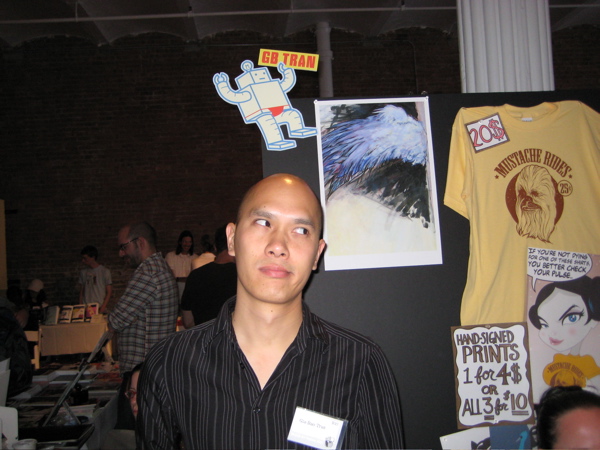
This man

told me to update my blog more regularly. Or he will do this:

So, today, some thoughts on eating at parties, and looking good afterwards:
Lest I give the impression that I appreciate party guests only in proportion to how much food they dispose of, let me tell you about this paranoid reality I survived when I first started trying to lose weight. As at many middle-class American gatherings, talk at the parties I attended often revolved neurotically around diet and suitably cosmetic emaciation. Young wives paraded their newly trim husbands, boyfriends displayed on an arm their slim dates, such words as “yoga”, “pilates”, “South Beach”, and “Atkins” fell like so much chattered confetti on the luscious dip of pure sour cream while hands darted for the brownie squares. I felt the presence of a feral undercurrent around the snacks buffet. » Read the rest of this entry «
October 21st, 2007 § § permalink
Do you know, you go along for years thinking nobody’s onto you, and then… I mean, you think because you’ve had a thought but never mentioned it to anyone, even in passing, that no one knows what you’re talking about, and you’re one of the few to have thought it. Then, there it is in print. Listen to this: “By a back-derivation typical of pop revivals, the fantasy glamour of the original songs is translated into a description of the era in which they originated: in the case of the old-new Bacharach craze, as if life in the early Sixties had been a live-action Dionne Warwick song, with deft periodic accentuation by oboe, xylophone, or celeste.†A Geoffrey O’Brien piece from the NY Review of Books, which unfortunately you can’t read without paying. » Read the rest of this entry «