September 21st, 2013 § § permalink
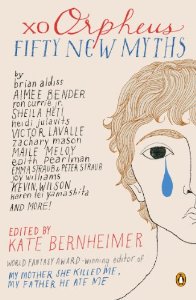
“Icarus flies once more,†begins Penguin’s press release for Kate Bernheimer’s anthology XO Orpheus. It goes on:
Aztec jaguar gods again stalk the earth. An American soldier designs a new kind of Trojan horse—his cremains in a bullet. Here, in beguiling guise, are your favorite mythological figures alongside characters from Indian, Punjabi, Inuit, and other traditions.
Exciting, right? In XO Orpheus, “Fifty leading writers retell myths from around the world in this dazzling follow-up to the bestselling My Mother She Killed Me, My Father He Ate Me,†which won the World Fantasy Award in 2011. Georges-Olivier Châteaureynaud’s story “An Occasional Icarus†features in a star-studded table of contents including Aimee Bender, Emma and Peter Straub, Heidi Julavits, Maile Meloy, Joy Williams, Sheila Heti, Edith Pearlman, Ben Loory, Brian Evenson, and more. I’m delighted to have gotten Châteaureynaud into this collection, as well as an excerpt from David B.’s The Armed Garden, from Kim Thompson’s Fantagraphics translation. Kate Bernheimer, founder and editor of the literary journal Fairy Tale Review, is the author of the story collections Horse, Flower, Bird and How a Mother Weaned Her Girl from Fairy Tales, among many other books. As she puts it:
If “xo†signals a goodbye, then xo Orpheus is a goodbye to an old way of mythmaking. Featuring talkative goats, a cat lady, a bird woman, a beer-drinking ogre, a squid who falls in love with the sun, and a girl who gives birth to cubs, here are extravagantly imagined, bracingly contemporary stories, heralding a new beginning for one of the world’s oldest literary traditions.
A starred review from Booklist says:
Edith Hamilton, the great classicist who made Greek mythology accessible, is officially put on notice by this explosive anthology of reimagined myths. Demeter, a divorced mom, struggles with the half-year custody of her daughter. Narcissus, a tart-tongued partier, offers lodging to a bewitching street urchin named Echo. And a Vietnam veteran, in the spirit of Daedalus, builds an emotional labyrinth for his son.
In this searing yet ebullient collection, contemporary authors and one graphic artist move beyond merely updating classic myths of multiple cultures by performing gut-rehabs while maintaining the stark, terrifying moments of fate-altering choices. Outsized appetites figure prominently—for power, perfection, or even one’s own children… The form is as inventive as the content… as these new myths attest, the frightening, timeless themes remain.
September 15th, 2013 § § permalink
A story by the recluse and outsider writer I profiled at Weird Fiction Review this summer is now up in the 50th issue of The Collagist, the online revue from Dzanc Books. Thanks much to editor Gabe Blackwell, I am delighted to have Bettencourt feature in such a lineup.
His tale, entitled “Incidents of Travel Among the Metamorphosians,†is a science-fiction fable of Calvino-esque whimsy. Topics covered: interstellar anthropology and tourism, accidental infidelity, dead cats, evolution, imitation, malleable (and living) architecture, divinity. A taste:
“They stared at us wide-eyed, when they had eyes; I remember that character with a phallus-shaped head, his mouth at the top of his skull, who spoke in a cavernous voice. ‘And your God,’ said he, ‘what became of him?’â€
September 15th, 2013 § § permalink
September 10th, 2013 § § permalink

At The Onion AV Club, recent Hugo-winning editor Jason Heller has some kind, considered words for Jérémie Dres’ travel memoir, published last year in Britain by SelfMadeHero and recently released in the US by Abrams. We Won’t See Auschwitz recounts the trip two French brothers of Jewish descent take to Poland in search of their roots, and what it means to be Jewish in Poland today.
The narrative structure is deceptively complex, much like Dres’ linework; fluid and uncluttered, his vivid renditions of himself, his brother, and those they encounter in Poland float in unframed panels across the page like untethered memories. The parallels to Jonathan Safran Foer’s Everything Is Illuminated are clear, but it isn’t just the graphic-novel format that sets Dres’ book apart; it’s his ability to more fully ponder the dimensionality, and the baggage, of his own identity. Ultimately, it’s the double meaning of the book’s title—the brothers’ anticlimactic avoidance of Auschwitz, plus the idealistic hope that a holocaust on that scale will never happen—that We Won’t See Auschwitz most poignantly probes.
Interestingly, the “double meaning of the book’s title” that Heller notes in closing is not present in the original French, Nous n’irons pas voir Auschwitz: literally, “We Won’t Go See Auschwitz.” The subtraction of a tiny active verb alters meaning… surely a case of gain in translation? Ttranslation (theory and practice) can only gain in contemporary discourse from being reframed as form of adaptation between the media of different languages, adaptation perhaps being the most common creative practice of our time. Currently, one of the contested criteria for the originality of derivative work (remix vs. adaptation) in adaptation theory is “added value.”
September 1st, 2013 § § permalink
August 27th, 2013 § § permalink
August 23rd, 2013 § § permalink
August 21st, 2013 § § permalink
August 20th, 2013 § § permalink
Congratulations to the estimable troika of Ann VanderMeer, Jeff VanderMeer, and Adam Mills for their World Fantasy Award nomination in the Special Award – Professional category for Weird Fiction Review! It’s been my honor to have a regular column there for the last two years. Ann and Jeff have done a bang-up job with their brainchild, the most all-guzzling and progressive portal to things Weird now available, but it would never work without Adam, who editorially oversees operations. Best of luck to them this fall in Brighton!
August 19th, 2013 § § permalink