“When I am, as it were, away, flitting between other worlds and other bodies, I still have a life here; a version of me remains, living on, inhabiting my house and my body and going through all the appropriate motions concomitant with existence, though by all accounts I am, in the shape of this residual self, quite astoundingly boring. According to my housekeeper and a few other people who have encountered me in this state, I never leave the house, I sleep a great deal, I will eat but not cook for myself, I am reluctant to get dressed properly and I show no interest in music or conversation. Sometimes I try to read a book but sit staring at the same page for hours, either not really reading it or reading it over and over again. Art books, paintings and illustrations appear to pique my interest as much as anything, which is to say not very much at all, as will a television programme, though only if it is visually arresting. My conversation becomes monosyllabic. I seem happiest just sitting in the loggia or staring out of a window at the view.” ~ Transition, Iain Banks
La rue de la glace
July 11th, 2010 § 0 comments § permalink
Though little could be further than glaces from the stifling weather we’re having. Two views of the same street, ’round the corner from where I’m staying, by day…
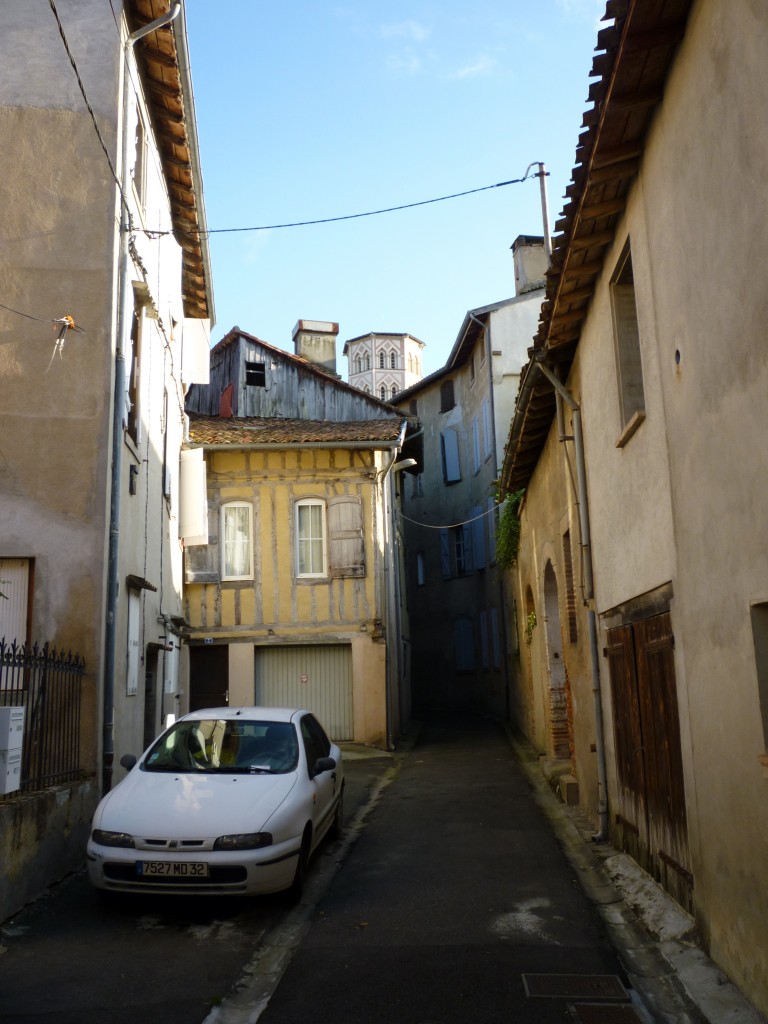
and night…
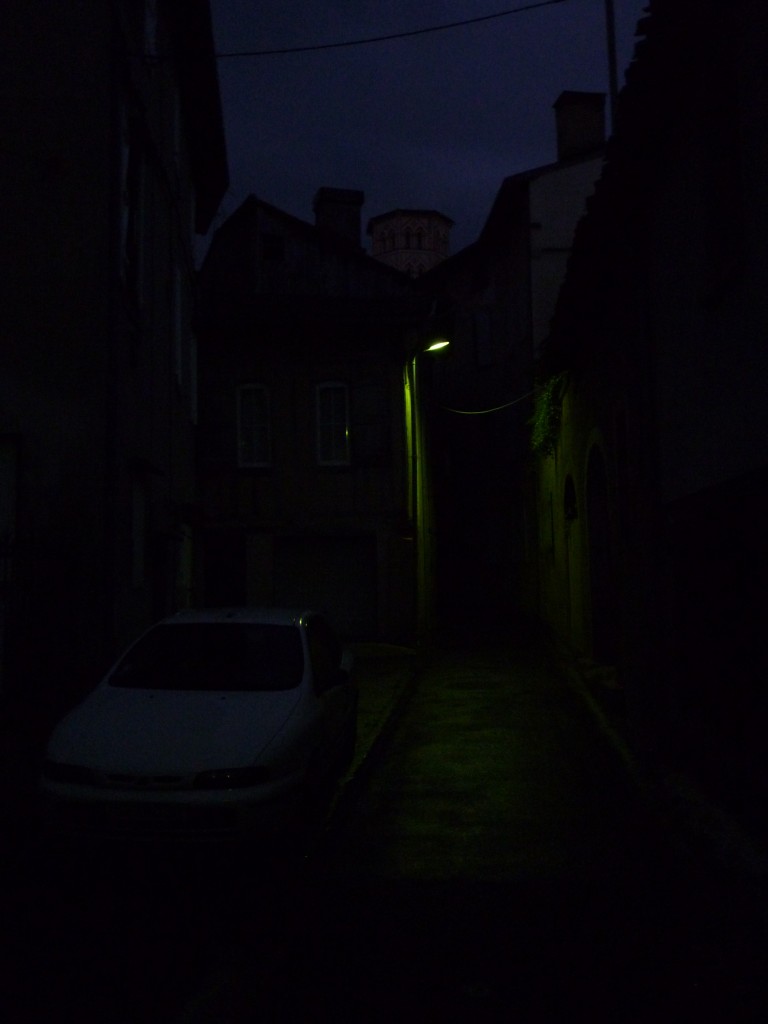
That’s the tip of the cathedral bell tower in the background, octagonal and vaguely Italianate.
Soccer is on everyone’s mind
July 10th, 2010 § 0 comments § permalink
in Europe, of course, and probably the whole world over outside the States (Oh, when will the Nobel equivalent of some sports authority accuse us of being “insular†and not participating in the global athletic conversation?), except in those US publications whose gazes are directed outward, toward foreign cultures, where you’ll find my two latest translation publications:
- in the July “Sports” issue of Words Without Borders, an excerpt from Anouar Benmalek’s story “The Penalty”
- Soccer also makes the cover of July’s World Literature Today–John Turnbull’s “The Literary Landscape of Soccer”–which otherwise sports Sherman Alexie’s grinning mug. Inside, check out my translation of Belgian Bernard Quiriny’s “Fear of the First Line,” the title story of his first collection.
Enjoy!
John Dryden Translation Competition 2010
July 6th, 2010 § 1 comment § permalink
I am well chuffed to report that for André Pieyre de Mandiargues’ short story “Le pain rouge†[The Red Loaf], I’ve won first prize in this year’s edition of its annual John Dryden Translation Competition, sponsored by the British Comparative Literature Association (BCLA) and the British Centre for Literary Translation (BCLT) at the University of East Anglia. This is sort of amazing, since the contest was open to translations from all languages, periods, and genres: poetry, prose, drama. I will be at the University of Kent in Canterbury tonight for the prize ceremony and reading at the 2010 BCLA conference. The conference theme this year is “Archive,” and the writer guest is Dubravka Ugresic.
Funny coincidence, ’cause when Chad Post (Ugresic’s US publisher) interviewed me last fall at ALTA for his “Making the Translator Visible” series, I said this was the hardest piece I’d done to date. It’s from the 1951 collection Le soleil des loups, or The Sun of the Wolves, an old peasant expression for the moon, which oversees magic and mayhem.
Mandiargues is one of the more hallucinatory, phantasmagoric writers I’ve worked on, affecting almost finicky dandyism when it comes to word choice, and lavish with arch, luxurious descriptions beneath which lurk palpable longing and menace. His particular brand of the fantastic was known for its brazen eroticism and manifest affiliation with the work of the Surrealists and Decadents. He was a friend of Paz and Cortazar in Paris. Calder & Boyars published his 1959 collection Feu de braise in a 1971 translation by April Fitzlyon. The 1963 novel La Motocyclette, alternately titled The Girl on the Motorcycle, appeared in two different translations, and was made into a film in 1967, as was his Goncourt-winning La Marge (The Margin, translated by Richard Howard).
Lazy Grady Day
July 4th, 2010 § 0 comments § permalink
Happy 4th of July! I promised my buddy Grady Hendrix that I would honor him by taking a day off pour ne rien faire, in the hopes that some of it would rub off on him psychically, as right now he’s deep in the nonstop no-rest-for-the-wicked trenches of this year’s New York Asian Film Festival, which he throws his heart and soul into running every year. (Well, ne rien faire for me meant biking about 8K uphill in the heat to the nearby village of Noilhan, where they were having a town-wide garage sale. Maybe I’ll write about that some other time.)
Today is that day, and in celebration, I present this wholly off-the-cuff translation of Thomas Fersen’s “Je n’ai que deux pieds,” an amiable paean to utter slackerdom. Those who read French may consult the much wittier original lyrics.
People tell me I’m a lazybones
Don’t mind no one’s business but my own
That’s to say, not a lot
Can’t mind business I don’t got
(chorus)
Pardon me, Madame
Only got two hands
I don’t give a damn
I am what I am
I’ve got dishes piled in the sink
And my dirty laundry’s got a stink
Unwashed hair, scruffy beard
But who cares if I look weird
(chorus)
Outside, there’s construction on the street
Like to watch construction on the street
People say, Move it, son,
Gangway, buddy; gotta run
(chorus)
Girlfriend’s screaming that I’m late again
Then she asks me where the hell I’ve been
Isn’t this just like you
You were supposed to help me move
I am writing these words on my balcony
July 3rd, 2010 § 1 comment § permalink
in the failing light. Tonight, to celebrate completing the first draft of a short story, I went for dinner at the only restaurant in town, in the only hotel in town. By the time I left, the back patio was full: two couples, a family of five, four friends, an older man who’d been there when I arrived. We had the same set menu (the “Majanâ€), with the same entrée, but his pavé de boeuf was rarer than mine, and afterward, he went for caramel rather than pistachio ice cream. He sat there, shirt open halfway down his chest, smoking a brown cigarette down to the butt and tapping it, from time to time, into the only ashtray at any of the tables. I couldn’t smell it or the pool chlorine from where I sat, nearby, facing the patio stairs with a view down the long hall of the lobby through the front door open to the street. I watched all the diners wander in; if the hotel had guests tonight, they were eating elsewhere. Once in a very rare while, a truck thundered by. In the corner of the patio was a old-fashioned streetlamp, a bit taller than a coat rack, that never went on. Sometimes, from a speaker in the bushes where a black stray was on the prowl, came a song I knew: “Forever Young,” “Je t’aime (moi non plus),” “Downtown.” The only waiter was young and scrawny, his right arm sheathed in a tribal tattoo; partway through dinner his shirttail came untucked and stayed that way. On the bill, I saw his name was Benjamin.
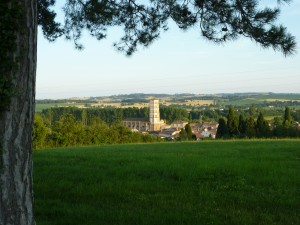
In honor of my set menu, I hiked up to the chapel of the town’s patron saint. On the way, you pass something like a brick chimney, topped by a Madonna, marking the spring, now dry, where St. Majan is said to have vanquished a dragon by throwing his ring in its mouth. From atop the hill, you get a nice view of town, the development across the river, and the rolling hills around (taken before my two-month-old camera died. Damn you, Panasonic!).
The chapel is flanked by pines but has been locked against vandals. On a near rise are the remains of a long, low farmhouse: the fractured roof timbers, the whole near wall of unbaked earth still in one piece, but reeling as though from a mighty blow. A great part of the charm of age is crookedness, I think. Somehow, in America, decrepitude bespeaks only neglect, or the cheap residue of expedience, but here roofs sag beneath the weight of centuries and seem canny survivors.
Lombez is the kind of town where at nine on a Saturday night you can walk down the middle of the main drag because there’s no traffic. At one end is what used to be a hotel where a passenger and mail coach changed horse teams. Residents of the various apartments have decked with flora the cobblestone courtyard, which now seems inviting as a tropical oasis. In a faded stencil font over someone’s door it says: Lime Depot. The river Save is much lower than it was, after a week of blistering heat. You can sit on the edge of the bridge and see where, thronged by green, a single Calla lily seems to mark a virgin spring, or the spot where a saint’s blood was spilled. A little farther on is a green rowboat, picturesquely moored beneath a willow.
Around the Web this Week
July 2nd, 2010 § 0 comments § permalink
Friend and fellow Clarionaut, the terrific writer Shauna Roberts, interviews me at her blog. Not much action hereabouts this week, because I’ve been guesting at Well-Read Donkey. Catch up with the posts if the topics below intrigue you! At both places, I wax logorrheic (and hopefully lyrical) on fantasy, writing, translation, and Châteaureynaud.
Monday: A Translator’s Journey
Wednesday: Ways of Reading Châteaureynaud and the Fantastic
Friday: How to Find an Author
Announcing The Consulate at Joyland
June 30th, 2010 § 0 comments § permalink
The estimable Joyland expands its virtual empire of great writing by inaugurating The Consulate, a new section among its far-flung city outposts, dedicated to world writing in translation. For the first few months out of the gate, I am the lucky guest editor. Check back at the Consulate in late July for exciting international short fiction!
Spotted at Greenlight Books
June 29th, 2010 § 0 comments § permalink
in Brooklyn, NY. Thanks, Greenlight!

Photo courtesy my friend Josh Furst, who read there recently for BOMB magazine.
This Week: Guest Blogging
June 28th, 2010 § 0 comments § permalink
This week–well, Monday, Wednesday, Friday–I’ll be guest blogging about A Life on Paper, Georges-Olivier Châteaureynaud, and translation at The Well-Read Donkey, one of three blogs from Kepler’s Books, fine independent purveyor of quality literature in Menlo Park, CA. The blog is run by the lovely Aggie Zivaljevic, who coordinates Kepler’s Writing Group. Its mission:
to connect Kepler’s Writing Group with other writers, readers, published authors and independent booksellers. Send us your book recommendations, tell us where is your favorite place to read, post the photo of your book shelf or your favorite book with dog-eared pages and post-it notes, tell us your favorite book to give this year, share your thoughts on writing craft, etc.