May 11th, 2015 § § permalink
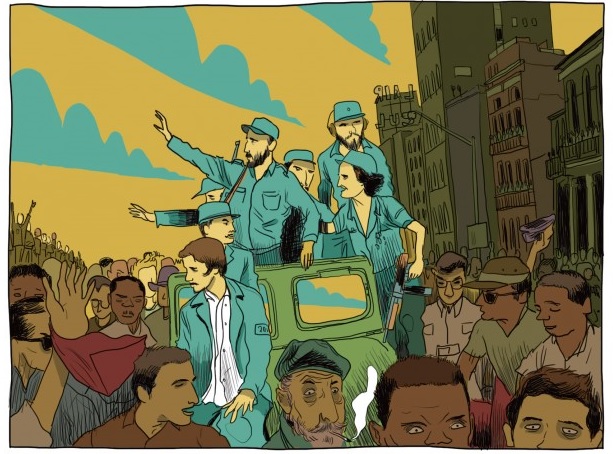
The annual Words Without Borders Comics Issue ran in February, but thanks to the miracle of the interwebs, it’s still available to be greedily perused! Check out an excerpt from Black Spring, the memoir of Cuban political refugee Alejandro González Raga as told to author Maxence Emery and illustrated by Thomas Humeau. Raga was a victim of the titular event, a 2003 dissident crackdown. The excerpt covers Raga’s childhood among citizens block committees, and the free flowering of adolescence cut short by government repression.
May 9th, 2015 § § permalink
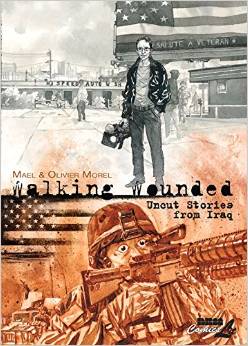
Over at Guernica, an excerpt from Walking Wounded: Uncut Stories from Iraq and Afghanistan, by Olivier Morel and artist Maël. It’s a graphic novel companion piece to the documentary On the Bridge, which tracks the repercussions of PTSD on several soldiers returned from the front. It was a privilege to work on this sensitive and searing book of graphic journalism.
May 7th, 2015 § § permalink

I hope to translate more of Xavier Mauméjean, the current reigning French master of the reimagined or “alternate†history, that SF subgenre. In January, he contributed “Cinépanorama” to Words Without Borders’ theme issue on alternate histories, guest edited by Gabriel Saxton-Ruiz. It seeks to answer the question: what if Alain Delon lost an eye during military service in Indochina and never became a movie star? Here’s an excerpt:
In your hotel room on Boulevard Rochechouart, you flip through the magazines. One photo at a time, so your eye won’t get tired. It takes you until late in the night. There’s no such thing as an innocent gaze. So you slip on your trenchcoat, headed for Pigalle. Smuggled cigarettes, gold-plated bracelets fallen from a truck, junk you pawn off on the gigolos just to seem in the know. Not that you’re diving into any fishy-smelling sidelines—the only thing you want to smell is Romy Schneider’s perfume. Pretty girl. You could’ve had her. A quick double espresso at the bar by the drag queens, maybe a croissant. Next to you, the mailman’s peeling his hard-boiled egg. Half of it disappears in one bite. You look away. The yolk’s yellow circle reminds you of an eye.
Xavier Mauméjean has a degree in philosophy and science of religions. He has won the renowned Rosny Award (the most important French award for science fiction) in 2005 and 2008. Mauméjean is also the author of short stories and radio plays for France Culture (winning the Grand Prix de la Radio in 2014), and works for television and cinema. He lives in the North of France, with his wife and their daughter, Zelda.
May 5th, 2015 § § permalink

Jean-Philippe Toussaint’s brief essay “For Samuel Beckett” is available online as a complement to Gulf Coast‘s Winter 2015 issue. Here’s an excerpt:
In the early ’80s, I wrote Samuel Beckett a letter. I explained that I was trying to write, adding that he was probably often sought out by strangers, and so rather than asking him to read my work, suggested instead we play a game of correspondence chess with, at stake, a play I’d written. If I won, he’d read it and give me his opinion. If he won, I’d read over my own play at my leisure. I closed my letter with these words: “Just in case, 1. e4.†By return post, Samuel Beckett replied, “Black resigns. Send the play. Sincerely. Samuel Beckett.â€
JEAN-PHILIPPE TOUSSAINT (1957 Р) is a Belgian writer and filmmaker whose books have been translated into more than twenty languages. The author of nine novels, he is the winner of numerous literary prizes, including the Prix M̩dicis in 2005 for his novel Running Away, and the Prix D̩cembre in 2009 for The Truth about Marie, the two middle books of the Marie tetralogy. These essays are taken from the collection Urgency and Patience, forthcoming next spring from Dalkey Archive Press.
May 3rd, 2015 § § permalink
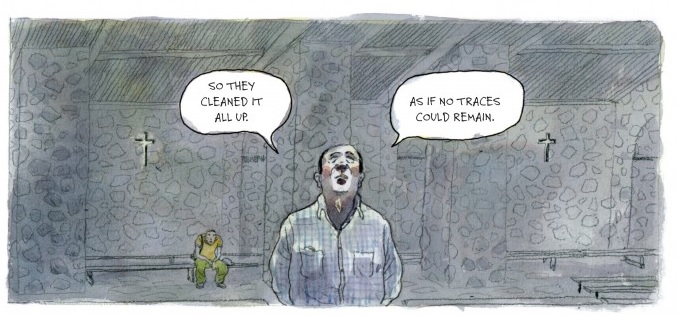
Penned by Patrick de St. Exupéry’s (Antoine’s son), a career foreign correspondent, the very graphic 2014 graphic novel Whim of the Gods blends fact and memory as he revisits Rwanda on the anniversary of the genocide he witnessed there twenty years ago, in 1994. Artist Hippolyte’s sensitive watercolors provide a heartbreaking counterpoint to the human devastation. Read an excerpt at Words Without Borders.
May 1st, 2015 § § permalink

Bengal Lights, in its latest issue (Autumn 2014), features an excerpt from Bernard Quiriny’s satire “Black Tides,” the fifth story I’ve published from his multi-prizewinning 2008 collection Contes carnivores.
Bengal Lights is a literary journal out of Dhaka, Bangladesh.
Our tastes are cosmopolitan: no location, no writer, no genre is off-limits. we welcome all writers: established or beginning, grizzled veterans or fresh-faced newbies, versed in the classics or cyber-narratives. we also seek to publish quality writing from bangladesh and south asia, but above all we seek to be engaged, to be a bazaar where all genres can mingle and multiply.
We seek writing that reflects the spirit and diverse voices of bangladesh and the rest of south asia. we also want expressive writing from the wider world beyond it. we are searching for fresh voices and new talent. we seek to forge literary connections between bangladesh and the wider world.
Here’s an excerpt:
The lights went down, and the first image was projected onscreen. It showed smoke shot from a helicopter: a gigantic black mushroom, quite alarming. After that we saw the oil tanker in different stages of sinking, then the massive flood that escaped its tanks and spread over the ocean. The club members waxed ecstatic like art lovers before a stormy sky by El Greco. Philippe narrated his photos, recounting his feelings on beholding such scenes of desolation. Next came the photos taken from the coast, when the sheet of bunker fuel hit shore. If the aerial shots were still bearable for being relatively abstract, these were so repulsive as to turn one’s stomach: petroleum patties stuck to the rocks like sooty buboes, birds bogged down to their beaks, natives pathetically trying to gather the spill with rakes, and even a lost little boy, his feet in fuel oil, a gluey patty he gazed at disgustedly in his hand, not knowing whether to hurl it far away or hang on to it so as not to add to the general desolation. It was appalling. Gould came and sat down beside me, murmuring a gentle reprimand: “Remember, morality has no place here! The disaster has already happened; it’s not our fault, nor is it within our power to repair. So check your guilt at the door.†I tried as best I could to suppress my nausea; all around me, the club members were purring with pleasure. It was very strange: the sight of oil-covered animals, soiled beaches, and lichens sopping with petroleum aroused in them the same kind of reaction that pornographic pictures did in the average person. These lovers of black tides weren’t just perverts: they were in fact connoisseurs of a special kind of obscenity, akin to refined erotomaniacs whose tastes run only to sophisticated depravities.
Belgian Bernard Quiriny (1978 – ) is the author of three short story collections: L’Angoisse de la première ligne (Phébus, 2005), which won the Prix Littéraire de la Vocation; Contes carnivores (Seuil, 2008), which won Prix du Style, the Prix Marcel Thiry for fabulism, and Belgium’s top literary prize, the Prix Rossel; and Une collection très particulière (Seuil, 2012), which won the Grand Prix de l’Imaginaire. He has also written two novels: Les assoiffés (Seuil, 2010), a satirical dystopian alternate history of Belgium as a feminist totalitarian state, and most recently Le village évanoui (Flammarion, 2014), as well as a biography of symbolist poet Henri de Régnier, Monsieur Spleen (Seuil, 2013). His work has appeared in English in Subtropics, World Literature Today, The Coffin Factory, Weird Fiction Review, and Dalkey Archive’s Best European Fiction 2012.
April 29th, 2015 § § permalink

Pakistani literary journal The Missing Slate has published my translation of Jean Muno’s flash fiction “The Chair”! Here’s an excerpt:
Stranger still: the chair was only there till it wasn’t. This happened more or less quickly, and always unexpectedly. It took advantage of a moment’s inattention, a brief absence on Frederick’s part, to vanish, so quickly that he’d never actually seen it vanishing. Every morning for two weeks now, the chair had escaped him. He would have had to keep an eye on it without let-up, not look away before the sun was fully up, but he had neither the patience nor the leisure.
Jean Muno is the greatest of Belgium’s Silver Age fabulists, heir to Jean Ray and Thomas Owen. His ever-wicked humor skewers the absurdity of the suburbs and their spiritual emptiness. The author of nine novels and four story collections, he received the Prix Rossel in 1979, and was a member of Belgium’s Royal Academy of Languages and Literature. His work has appeared in Weird Fiction Review and is forthcoming in Year’s Best Weird Fiction Vol. 2.
April 27th, 2015 § § permalink
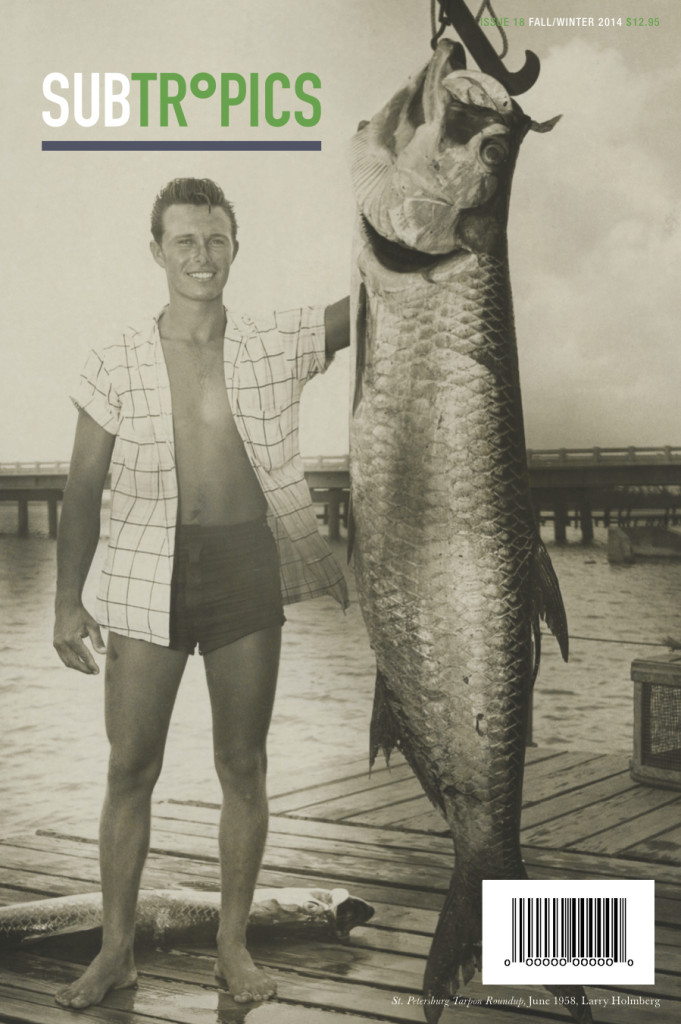
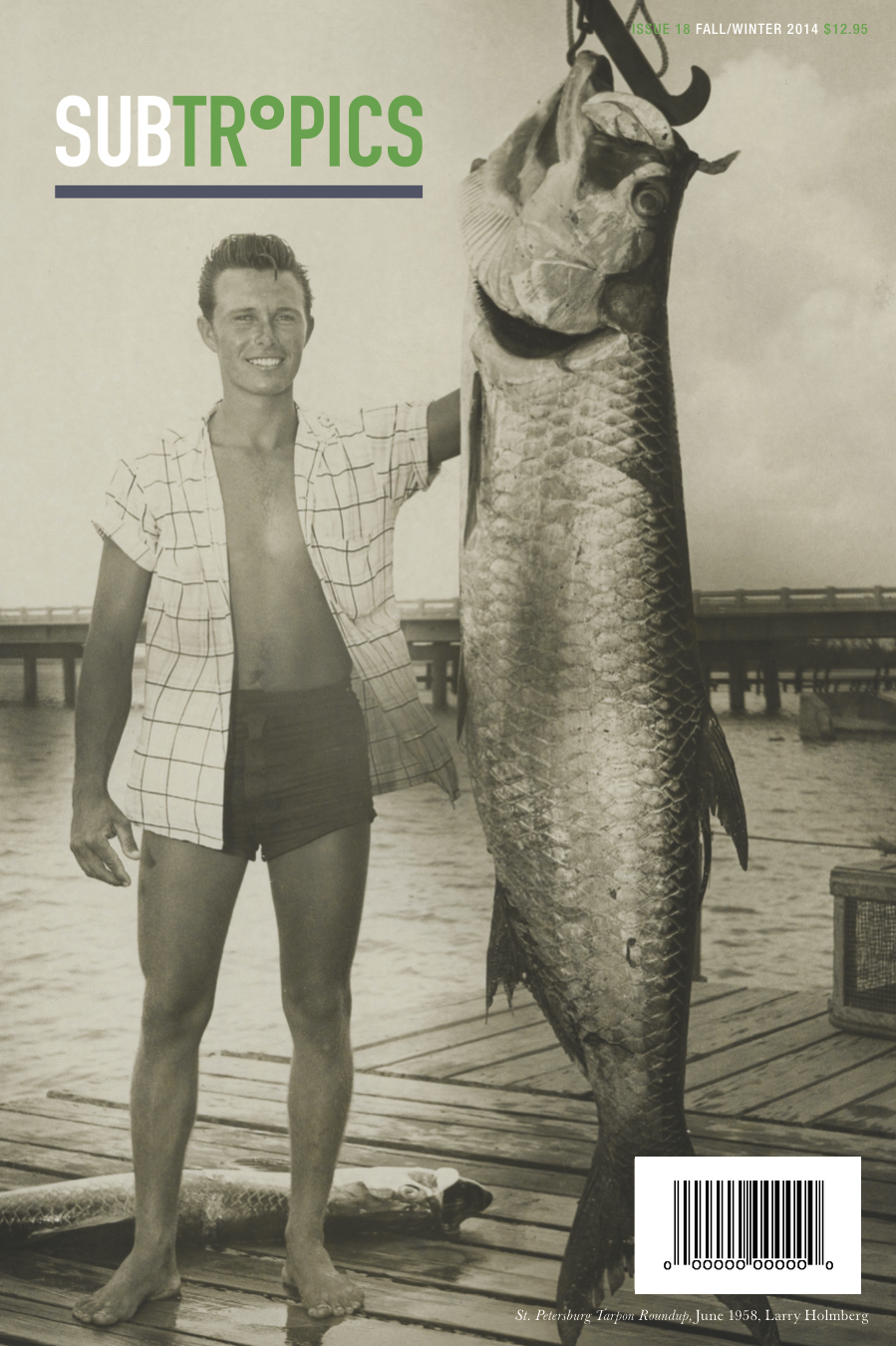
Issue 18 (Fall/Winter 2014) of the erstwhile Subtropics features Bernard Quiriny’s story “A Neverending Bender,” the fourth story I’ve published from his multi-prizewinning 2008 collection Contes carnivores. Here’s an excerpt:
When my brother and I were children, Dad had a safe in his office where he hid his papers, money, and a revolver. The office was off-limits; John and I were not allowed to set foot inside. But one day, our games led us there. The safe was open, and I remember catching sight of a little bottle which, habitué that I was of falling off bikes, I took for astringent. (That very night, I gave myself away by telling my father that he should keep the bottle in the medicine cabinet, thus revealing that I’d disobeyed him.)
What did that bottle contain? In light of the manuscript we’ve just seen, I find it hard to believe it wasn’t zveck.
Belgian Bernard Quiriny (1978 – ) is the author of three short story collections: L’Angoisse de la première ligne (Phébus, 2005), which won the Prix Littéraire de la Vocation; Contes carnivores (Seuil, 2008), which won Prix du Style, the Prix Marcel Thiry for fabulism, and Belgium’s top literary prize, the Prix Rossel; and Une collection très particulière (Seuil, 2012), which won the Grand Prix de l’Imaginaire. He has also written two novels: Les assoiffés (Seuil, 2010), a satirical dystopian alternate history of Belgium as a feminist totalitarian state, and most recently Le village évanoui (Flammarion, 2014), as well as a biography of symbolist poet Henri de Régnier, Monsieur Spleen (Seuil, 2013). His work has appeared in English in Subtropics, World Literature Today, The Coffin Factory, Weird Fiction Review, and Dalkey Archive’s Best European Fiction 2012.
April 25th, 2015 § § permalink
The Missing Slate, a Pakistan-based online litmag “for the discerning metropolitan,†was created with intent to uphold free speech irrespective of geography, political or religious affiliations.
Our goal is simple: honor talent and incorporate as many styles, opinions and cultures as possible. The magazine is a “borderless†one with a culturally and intellectually diverse team that believes if art can’t be quantified, it can’t be mapped either.
They were awesome enough to feature a a deep cut from the Georges-Olivier Châteaureynaud archives: the first story from his first collection, the 1973 triptych entitled Le Fou dans la chaloupe [The Madman in the Rowboat]. “His Final Pages†is a Borgesian mindbender, and a fitting meditation on mortality from a writer who, even as an young man, was concerned with an old man’s questions of death, debility, and the writing life, and the hollowness of success. Here’s an excerpt:
This much I have always known: to write is a disgrace. Don’t they know, who boast of it naively, that in every age it has mainly drawn the weak and mediocre, the spineless, eccentric, and effeminate, who found no other fitting activity? A man sound of mind and body does not write; he acts on, delights in, the real. Blessed are they who forget—screwdriver, bazooka, or slide rule in hand—the ulcerous idleness of the universe, which unveils itself upon the slightest inspection. When I was thirty, the air that seemed to intoxicate everyone else gave me no joy to breathe. I was waiting for that illness to declare itself, the illness that would save me: a book.
Widely known in his native France, Georges-Olivier Châteaureynaud (1947- ) has been honored over a career of almost 40 years with the Prix Renaudot, the Prix Goncourt de la nouvelle, and the Grand Prix de l’Imaginaire at Utopiales. He has been published in Conjunctions, The Harvard Review, The Southern Review, Words Without Borders, AGNI Online, Epiphany, Fantasy & Science Fiction, Lady Churchill’s Rosebud Wristlet, Postscripts, Eleven Eleven, Sentence, Joyland, Confrontation, The Brooklyn Rail, Liquid Imagination, Podcastle, and The Café Irreal, as well as the anthologies Exotic Gothic 5 (PS Publishing, 2013) and XO Orpheus (Penguin, 2013). His volume of selected stories, A Life on Paper (Small Beer, 2010), won the Science Fiction & Fantasy Translation Award and was shortlisted for the Best Translated Book Award. His work has been compared to that of Kafka, Borges, Calvino, Cortazar, Isak Dinesen, and Steven Millhauser.
Like it? Consider buying Châteaureynaud’s volume of Selected Stories, A Life on Paper!
April 23rd, 2015 § § permalink

The latest issue of The Literary Review, dedicated to John le Carré, features a naughty bit of local color from ’50s Paris: an excerpt from Jean-Paul Clébert’s recently reprinted underground classic Paris insolite [Curious Paris], a memoir of homeless life in Paris said to have influenced Henry Miller and the Situationist principle of the dérive. Published in 1952 with a dedication to Robert Doisneau and photographs by Patrice Molinard, it was, in the author’s own words, “not a story in the journalistic sense, but a personal investigation.†It’s a freewheeling book, like On the Road. The excerpt is entitled “The Bawdyhouse for Beggars.” Here’s the opening:
BEFORE THE WAR there was, I think, in the Saint-Paul neighborhood on rue de Fourcy, a most astonishing public space, a whorehouse for hobos. This bedlam, now vanished from the earth if not its clients’ memories, whose sorely missed atmosphere can be readily imagined, consisted of two rooms-the Senate, where the rate was ten francs across the board, and the House of Representatives, where it hovered, according to mood and quality, around fifteen.
Jean-Paul Clébert (1926-2011) is the author of more than forty works of fiction and nonfiction. He left Jesuit school at 16, to join the French Resistance, and afterward, traveled Asia. In the 1950s, he frequented two related movements—dwindling Surrealism and burgeoning Situationism—as well as reporting from Asia for Paris Match and France Soir. The 1996 Dictionnaire du surréalisme, for which he single-handedly composed every entry, is widely considered a classic, as is his first book. Among other prominent works are The Blockhouse (1958), his only translated novel, and 1962’s Les Tziganes, a pioneering sociological study of Gypsies also based on personal experience, translated into English by Charles Duff (Dutton, 1963). His later works were dedicated to the history, nature, and culture of Provence, where he spent his final years.